
Language has layers that make it beautiful, but also confusing.
One classic example that baffles even advanced English learners is the choice between “whether it be” and “whether it is.”
Both sound correct, but they don’t serve the same grammatical function.
Understanding when and how to use each phrase can instantly make your writing sound more natural, polished, and accurate.
So, let’s break it down in simple terms — with examples, comparisons, and practical tips you can use right away.
Why People Get Confused Between “Whether It Be” and “Whether It Is”
Most confusion comes from how English moods work — especially the subjunctive and indicative moods.
Both phrases start with “whether”, but the verbs “be” and “is” change the meaning and tone of the sentence.
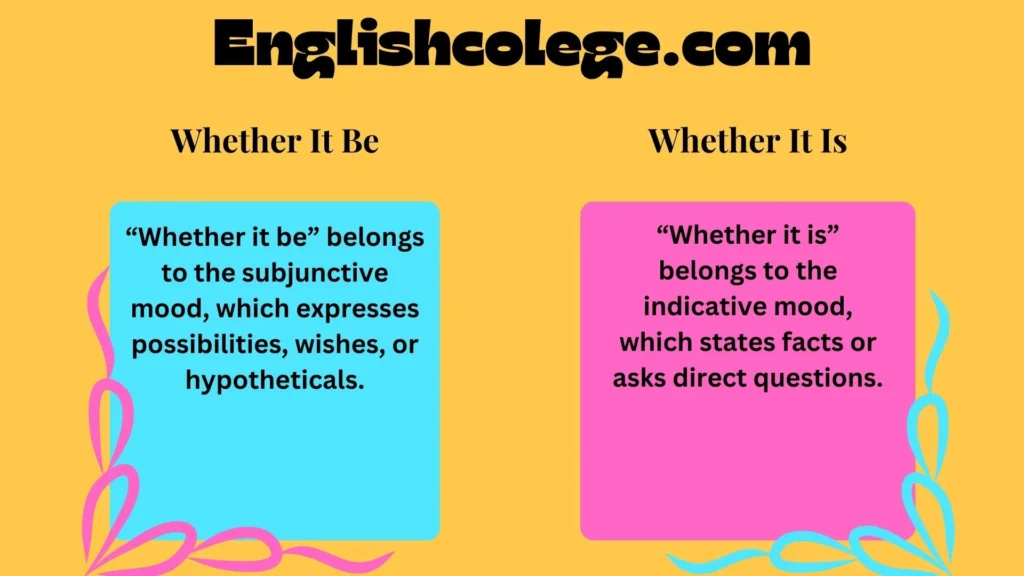
- “Whether it be” belongs to the subjunctive mood, which expresses possibilities, wishes, or hypotheticals.
- “Whether it is” belongs to the indicative mood, which states facts or asks direct questions.
Let’s explore what that really means.
Indicative vs. Subjunctive Mood — The Core Difference
Before we jump into each phrase, it’s essential to grasp the difference between the two moods that drive this distinction.
What Is the Indicative Mood?
The indicative mood is what we use most of the time. It expresses things that are factual, real, or certain.
Examples:
- “She is coming to the meeting.”
- “I wonder whether it is true.”
It deals with reality. You’re talking about something that is or is not.
What Is the Subjunctive Mood?
The subjunctive mood expresses something hypothetical, uncertain, wished for, or not yet real. It often shows up in formal, poetic, or old-fashioned English.
Examples:
- “Be it rain or shine, we’ll play.”
- “I suggest that he be on time.”
Notice that “be” replaces “is” or “are” — that’s the hallmark of the subjunctive mood.
Quick Comparison Table
| Mood | Function | Example | Tone |
|---|---|---|---|
| Indicative | States fact or question | “I don’t know whether it is correct.” | Modern, neutral |
| Subjunctive | Expresses hypothetical or wish | “Whether it be right or wrong, I’ll decide.” | Formal, poetic |
Understanding this table helps you see that the verb choice changes the mood and the level of certainty in your sentence.
The Subjunctive Side: “Whether It Be”
The phrase “whether it be” lives in the world of possibility and formality. It doesn’t describe what’s real — it suggests what could be, might be, or should be.
Definition and Usage
“Whether it be” is the subjunctive form of “whether it is.” It’s used when you’re talking about something hypothetical, uncertain, or when tone and formality matter.
Examples:
- “Whether it be day or night, he works hard.”
- “We’ll support the project, whether it be large or small.”
- “Whether it be luck or effort, she succeeded.”
Where You’ll See It Most
- Formal speeches: “Whether it be through unity or strength, we shall prevail.”
- Literary writing: Authors often use it for rhythm or emphasis.
- Legal or ceremonial language: “Whether it be known that…”
Why It Sounds Formal or Poetic
The subjunctive has a rhythmic, elevated tone. It sounds elegant, sometimes even old-fashioned. That’s why you’ll rarely hear “whether it be” in casual speech.
The Indicative Side: “Whether It Is”
Now let’s shift to the modern, everyday version — “whether it is.”
Definition and Usage
“Whether it is” expresses facts, certainties, or real possibilities — it’s neutral and direct.
Examples:
- “I don’t know whether it is true.”
- “We need to finish the work, whether it is easy or not.”
- “They argued about whether it is better to save or invest.”
Common Contexts
- Everyday conversation: It’s natural and clear.
- Academic and business writing: Keeps tone professional but not stiff.
- Informal writing: Works in articles, blogs, and essays without sounding old-fashioned.
Why It’s the Modern Standard
Modern English leans toward clarity and simplicity. Since “whether it is” sounds natural and straightforward, it’s preferred in most settings today.
Direct Comparison: “Whether It Be” vs. “Whether It Is”
Let’s compare them head-to-head to understand when each shines.
| Feature | Whether It Be | Whether It Is |
|---|---|---|
| Mood | Subjunctive | Indicative |
| Tone | Formal, poetic, rhetorical | Neutral, factual |
| Meaning | Hypothetical or imagined | Real or factual |
| Use In Writing | Literature, speeches, legal texts | Everyday speech, modern prose |
| Example | “Whether it be rain or shine…” | “Whether it is raining or not…” |
Key Takeaway
Both are correct — but context determines which sounds right.
If you’re writing something modern, conversational, or factual, use “whether it is.”
If your tone is formal, rhetorical, or artistic, go for “whether it be.”
When to Use Each – A Simple Decision Guide
You don’t need to memorize grammar rules. Here’s an easy checklist you can use.
✅ Use “Whether It Be” When:
- The situation is hypothetical or uncertain.
- You want a formal or poetic tone.
- The phrase appears in set expressions like “be it ever so humble.”
Example:
“Be it ever so small, an act of kindness changes the world.”
✅ Use “Whether It Is” When:
- You’re stating a fact or real condition.
- The tone is modern, clear, and neutral.
- You’re writing business, academic, or conversational English.
Example:
“You must decide whether it is worth your time.”
Decision Flowchart (Text Version)
Is the sentence factual or real?
→ Use “whether it is.”
Is the sentence hypothetical or formal?
→ Use “whether it be.”
Simple as that.
Common Mistakes and Misconceptions
Even advanced speakers trip up on these expressions. Let’s clarify a few traps.
❌ Mistake 1: Using “Whether It Be” to Sound Smarter
Many people think “whether it be” sounds more educated or elegant. But overusing it can make writing sound forced or archaic.
Better:
“I’ll finish it, whether it is hard or easy.”
Not
“I’ll finish it, whether it be hard or easy.” (Unless you’re writing a speech!)
❌ Mistake 2: Mixing “If” and “Whether” Incorrectly
Some try to replace “whether” with “if.” They’re not always interchangeable.
| Incorrect | Correct |
|---|---|
| “I don’t know if it is raining.” (Ambiguous) | “I don’t know whether it is raining.” |
| “Tell me if it’s true.” (Conditional) | “Tell me whether it’s true.” (Two options) |
Tip: Use “whether” when presenting choices; use “if” for conditions.
❌ Mistake 3: Confusing Subjunctive with Future Tense
Some learners think “be” refers to the future. It doesn’t — it’s a mood, not a tense.
Example:
“Whether it be tomorrow or next week, we’ll act.”
This doesn’t predict the future — it expresses uncertainty about when.
Practical Grammar Tips for Writers
If you’re a writer, editor, or student, mastering this nuance improves both clarity and tone.
💡 Tips to Remember
- Match mood to purpose. If it’s factual, use indicative (is). If it’s hypothetical, use subjunctive (be).
- Keep audience in mind. Don’t use old-fashioned forms in modern writing unless for style.
- Read aloud. Your ear will catch stiffness that your eyes miss.
- Use examples. Seeing sentences in context helps cement understanding.
✍️ Mini Practice Exercise
Try rewriting these sentences:
| Original | Rewrite Using Correct Form |
|---|---|
| “I wonder whether it be true.” | “I wonder whether it is true.” |
| “Whether it is rain or shine, we’ll go.” | “Whether it be rain or shine, we’ll go.” |
| “They’ll act whether it be necessary or not.” | “They’ll act whether it is necessary or not.” |
Practice makes perfect — switch between both forms until it feels natural.
Recap and Key Takeaways
Let’s summarize what you’ve learned:
- “Whether it be” → Subjunctive mood. Use for hypotheticals, formal tone, or poetic effect.
- “Whether it is” → Indicative mood. Use for factual, real, or modern contexts.
- Both are grammatically correct, but one suits old-school formality while the other fits modern clarity.
- Overusing “whether it be” can make writing sound dated or pretentious.
- Context is everything. Match your tone, intent, and audience.
Frequently Asked Questions (FAQs)
What is the main difference between “whether it be” and “whether it is”?
The difference lies in mood. “Whether it be” uses the subjunctive mood for hypotheticals, while “whether it is” uses the indicative mood for facts or certainties.
Is “whether it be” grammatically correct?
Yes. It’s perfectly correct but sounds formal or poetic. Use it in speeches, literature, or ceremonial language, not everyday conversation.
Can I use “whether it is” in formal writing?
Absolutely. “Whether it is” works in any context — business, academic, or conversational — because it’s neutral and modern.
Why does “be” replace “is” in the subjunctive mood?
The subjunctive mood drops tense distinctions and uses the base form of the verb (be, go, see) to express hypotheticals or wishes.
Which is better for SEO or online writing?
Use “whether it is” more often. It’s modern, easier to read, and aligns with how people search or phrase questions online.
Final Thoughts
Mastering the distinction between “whether it be” and “whether it is” can sharpen your English instantly. It’s more than grammar — it’s about tone, precision, and context.
- Use “whether it be” when your writing aims for grace, gravity, or imagination.
- Use “whether it is” when clarity and realism matter most.
As language evolves, both forms coexist — each with its own charm. The key is knowing which voice suits your purpose.
