

Getting confused between “Here is” and “Here are” happens to almost everyone — even fluent English speakers
. These two short phrases might look simple, but they hold a surprising amount of grammar logic beneath the surface.
In this guide, you’ll learn when to use “Here is” or “Here are”, how to spot the right form in tricky cases, and how to use them confidently in both writing and conversation.
Let’s dive in and make this topic crystal clear once and for all.
Understanding “Here Is” and “Here Are”
Before choosing between “is” or “are”, you need to know what’s really happening in the sentence.
- “Here” functions as an adverb of place, meaning “in this place” or “at this location.”
- “Is” and “are” are both forms of the verb to be, which shows existence or presence.
Together, they introduce or point out something or someone:
| Phrase | Function | Example |
|---|---|---|
| Here is | Used for singular subjects | Here is the book you wanted. |
| Here are | Used for plural subjects | Here are the books you ordered. |
Quick Tip: Think of “Here is” and “Here are” as signposts. They announce the arrival or existence of something. The difference lies in whether that “something” is singular or plural.
Grammar Foundation: Matching “Here” with the Right Verb
The key to using “Here is” or “Here are” correctly lies in subject–verb agreement.
In most English sentences, the subject comes before the verb. But with “Here” and “There” sentences, that order flips.
Example:
- Normal sentence: The keys are on the table.
- With “Here”: Here are the keys.
So even though the verb comes first, it still agrees with the subject after it.
✅ Rule: Match the verb (“is” or “are”) to the subject that follows, not to “here.”
Examples
| Sentence | Correct Form | Reason |
|---|---|---|
| Here is your coffee. | ✅ | “Coffee” is singular. |
| Here are your shoes. | ✅ | “Shoes” is plural. |
| Here is the reasons. | ❌ | “Reasons” is plural → should be “Here are the reasons.” |
When to Use “Here Is”
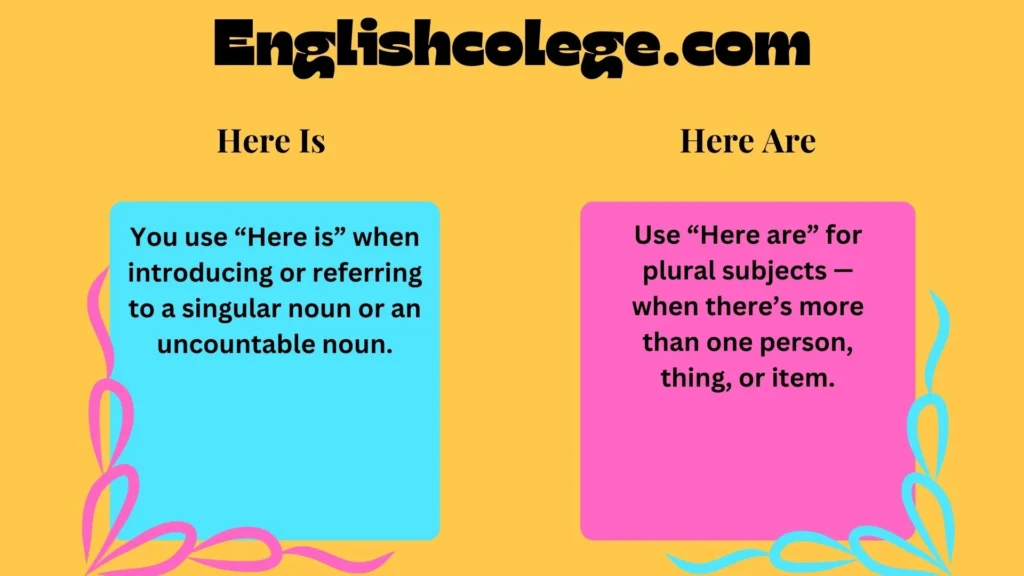
You use “Here is” when introducing or referring to a singular noun or an uncountable noun.
1. Singular Subjects
If you’re talking about one person, thing, or idea, use “Here is.”
Example:
- Here is your pen.
- Here is the document I promised.
- Here is my idea for the next campaign.
2. Uncountable Nouns
For nouns that can’t be counted — like water, money, or information — use “is.”
Example:
- Here is the money you lent me.
- Here is some water.
- Here is the advice you needed.
3. Titles, Quotes, and Abstract Ideas
Even when the title looks plural, it’s treated as a single entity.
- Here is “The Beatles Anthology.”
- Here is what I think about leadership.
Case Study:
In a customer service setting, saying “Here’s your receipt” feels natural and polite. It’s short for “Here is your receipt.” This contraction (“Here’s”) is used in daily English because it sounds friendly and efficient.
When to Use “Here Are”
Use “Here are” for plural subjects — when there’s more than one person, thing, or item.
1. Plural Nouns
Examples:
- Here are the results you requested.
- Here are your shoes and bag.
- Here are some ideas for your post.
2. Compound Subjects
When two or more nouns are joined with and, they take “are.”
- Here are John and Lisa.
- Here are the apples and oranges.
3. Group Introductions
If you’re introducing multiple people or things at once:
- Here are your team members: Sarah, Mark, and Joe.
| Correct | Incorrect |
|---|---|
| Here are your documents. | Here is your documents. |
| Here are my friends. | Here is my friends. |
Tip: Always look for the real subject — not what comes first in the sentence. “Here” doesn’t control the verb; the subject that follows does.
Countable vs. Uncountable Nouns
This rule is at the heart of correct verb usage.
| Type | Definition | Example Nouns | Example Sentence |
|---|---|---|---|
| Countable | Can be counted individually | book, car, apple | Here are the apples. |
| Uncountable | Can’t be separated into individual units | water, advice, money | Here is the water. |
Common Mistakes:
- ❌ Here are the news. → ✅ Here is the news.
- ❌ Here is the clothes. → ✅ Here are the clothes.
Grammar Fact: “News,” though ending in s, is singular because it represents a single concept — information.
Common Mistakes and How to Fix Them
Many errors come from guessing the verb form without checking the subject. Let’s fix that.
Mistake 1: Misplaced Verb Agreement
❌ Here is the keys.
✅ Here are the keys.
Why: “Keys” is plural, so it takes “are.”
Mistake 2: Overcorrecting
Some learners try too hard to sound correct, using “are” everywhere.
❌ Here are the information you asked for.
✅ Here is the information you asked for.
Mistake 3: Ignoring Contractions
Using “Here’s” sounds natural when speaking casually.
- Here’s your order. (spoken English)
- Here is your order. (formal writing)
Advanced Grammar Scenarios
Grouped Singularity
Sometimes multiple nouns act as one unit or concept, taking “is.”
- Here is bacon and eggs. (a single dish)
- Here is macaroni and cheese.
Contextual Plurality
Certain collective nouns can be singular or plural, depending on meaning.
- Here is the team. (referring to one unit)
- Here are the team members. (referring to individuals)
| Noun | Singular Meaning | Plural Meaning |
|---|---|---|
| Family | one household | individuals in it |
| Couple | one pair | two people |
| Staff | one group | several workers |
“Rest” Cases
When “rest” refers to the remaining items, verb choice depends on what follows.
- Here is the rest of the cake. 🍰
- Here are the rest of the cookies. 🍪
Quick Rule: The verb matches the noun after “of.”
Everyday Usage and Style Tips
1. “Here’s” Sounds Natural
In spoken English, contractions make speech smoother.
- Here’s your ticket.
- Here’s what I found.
However, avoid contractions in formal writing or academic contexts.
2. Avoid Awkward Sentences
If “Here are” feels clumsy, you can rephrase.
❌ Here are your two options:
✅ You have two options: or These are your options:
3. Use Emphasis Smartly
- Here’s the point I want you to remember.
- Here are the facts that prove it.
Pro Tip: Read your sentence aloud. If it sounds unnatural, you’ve likely chosen the wrong verb.

Practice Section: Test Your Understanding
Fill in the blanks with is or are.
| Sentence | Your Answer | Correct Answer |
|---|---|---|
| 1. Here ___ the keys you dropped. | are | |
| 2. Here ___ your phone. | is | |
| 3. Here ___ the news you were waiting for. | is | |
| 4. Here ___ some of my favorite books. | are | |
| 5. Here ___ the rest of the sugar. | is |
Challenge Yourself: Create three sentences of your own using “Here is” and “Here are” correctly.
Related Quick Guides
Boost your English fluency with these mini-lessons:
- Mayonnaise vs. Mayonaise – Spelling and Meaning
- Parol vs. Parole – Homophones Explained
- 12 Other Ways to Say “Doesn’t Make Sense”
- Widow vs. Widower – Gender Differences in Terms
- Seen vs. Scene – Homophones You Must Know
- Childlike vs. Childish – Nuances in Tone
FAQs
What’s the basic difference between “Here is” and “Here are”?
“Here is” introduces singular or uncountable nouns, while “Here are” introduces plural nouns.
Can I use “Here’s” with plural nouns?
In casual speech, yes — people often say “Here’s your keys.” But grammatically, it’s incorrect. Always use “Here are” in writing.
Is “Here’s” acceptable in formal writing?
No. In academic or business writing, use “Here is” instead of “Here’s.”
Why does “Here” come before the verb?
Because “Here” acts as an adverb introducing the subject. English sometimes reverses word order for emphasis.
What about phrases like “Here’s my friends”?
That’s a common mistake. Since “friends” is plural, it should be “Here are my friends.”
Conclusion
The secret to mastering “Here is” vs. “Here are” lies in subject–verb agreement. Once you identify the subject, choosing the right form becomes effortless.
Remember:
- Use “is” for one item or uncountable nouns.
- Use “are” for plural items or compound subjects.
- Always let the subject, not “here,” decide the verb.
Read aloud. Listen to how native speakers use these forms. Soon, you’ll instinctively know which one fits — and you’ll never hesitate again.
