

If you’ve ever hesitated while writing and thought, “Should I say correct or correctly?” — you’re not alone. Even fluent English speakers sometimes get this wrong. The difference between “correct” and “correctly” may seem small, but it changes how your sentence works.
This guide breaks everything down — from basic grammar rules to real-life usage, examples, and even quick tricks to remember the difference. By the end, you’ll know exactly when to use each one, confidently and correctly.
Understanding the Difference Between “Correct” and “Correctly”
Let’s start with the basics: “correct” is an adjective, while “correctly” is an adverb.
That means they serve different purposes in a sentence.
| Word | Part of Speech | Function | Example Sentence |
|---|---|---|---|
| Correct | Adjective | Describes a noun or pronoun | The answer is correct. |
| Correctly | Adverb | Describes a verb, adjective, or another adverb | She spelled the word correctly. |
So, “correct” describes a thing, while “correctly” describes an action.
Let’s unpack that with simple examples you can visualize.
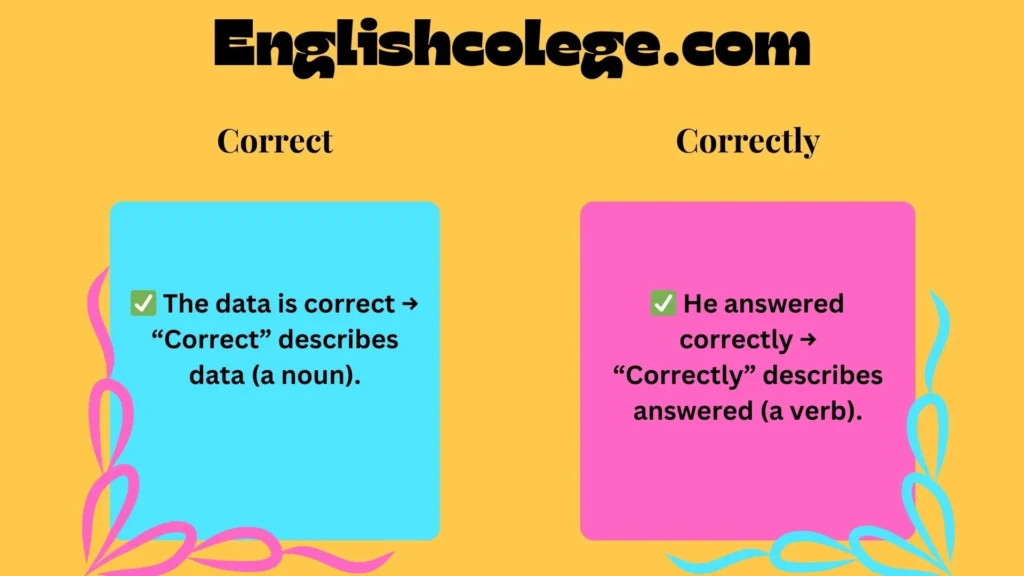
- ✅ The data is correct → “Correct” describes data (a noun).
- ✅ He answered correctly → “Correctly” describes answered (a verb).
See the shift? The first tells what something is. The second tells how something is done.
When to Use “Correct” in a Sentence (Adjective Usage)
Use “correct” when describing something or someone — it tells you whether something is right, accurate, or true.
It typically appears:
- Before a noun: the correct method, the correct answer, the correct time
- After a linking verb: is, seems, becomes, appears
Examples:
- The student gave the correct answer.
- This is the correct solution.
- Make sure you’re using the correct file format.
- Your calculations are correct.
Real-life tip:
In professional writing — like reports, essays, and instructions — “correct” often appears next to technical or factual nouns:
Please verify you’ve entered the correct password.
Here, “correct” modifies password, telling us which kind of password is needed — the accurate one.
When to Use “Correctly” in a Sentence (Adverb Usage)
Use “correctly” to describe how something happens. It tells the reader the manner or method in which an action was done.
Examples:
- She correctly predicted the outcome.
- You spelled the word correctly.
- The system is not functioning correctly.
- If I remember correctly, he left at noon.
Pro tip:
Adverbs like “correctly” usually go:
- Before the verb (She correctly answered.)
- After the verb (She answered correctly.)
Both are grammatically valid, but placement affects emphasis.
She correctly answered the question emphasizes the accuracy.
She answered correctly emphasizes the result.
Common Mistakes and Misconceptions
Even native speakers mix up “correct” and “correctly” in casual conversation. Let’s fix that.
❌ Common error:
You wrote the essay correct.
✅ Correct version:
You wrote the essay correctly.
Why: The verb wrote needs an adverb (it describes how you wrote).
❌ Another mistake:
He didn’t spell it correct.
✅ Correct version:
He didn’t spell it correctly.
Again, the verb spell needs an adverb.
Why the confusion happens
In spoken English, people often drop “-ly” endings for speed:
You did good! instead of You did well!
That’s informal and common in speech, but in writing, grammar rules matter. Adverbs like “correctly,” “quickly,” and “easily” make your writing precise.
Quick Grammar Test: Can You Spot the Error?
Try these five examples. Which are right?
| Sentence | Correct or Incorrect? | Explanation |
|---|---|---|
| You answered correct. | ❌ Incorrect | Should use “correctly” — it describes how you answered. |
| The correct option is A. | ✅ Correct | “Correct” describes option (a noun). |
| She pronounced the word correctly. | ✅ Correct | “Correctly” modifies the verb pronounced. |
| Make sure your form is correctly. | ❌ Incorrect | Should use “correct” — it describes form. |
| Everything is correct now. | ✅ Correct | “Correct” follows a linking verb (is). |
Comparative and Superlative Forms: “More Correct” or “More Correctly”?
This is where things get tricky.
Technically, both “more correct” and “more correctly” are grammatically valid.
But usage depends on context.
1. “More Correct”
Use when comparing things (nouns).
Your calculation is more correct than mine.
The newer version is more correct in detail.
This sounds a bit formal or scientific — it’s rare in casual speech but fine in academic writing.
2. “More Correctly”
Use when comparing actions (verbs).
She pronounced it more correctly than he did.
You used the formula more correctly this time.
Why not “most correct”?
In real-world writing, “correct” is usually absolute — something is either right or wrong. Saying “more correct” can sound odd unless you’re grading degrees of precision.
Example:
Answer A is correct, but answer B is more correct because it includes additional detail.
So yes — it’s valid but context-sensitive.
How “Correct” and “Correctly” Appear in Real Writing
To see how professional writers use both, let’s look at examples adapted from edited sources:
“The official report confirmed the data were correct.” — Scientific American
“The system correctly identified the patient’s medical condition.” — New England Journal of Medicine
In journalism and academia, you’ll notice:
- “Correct” appears after is/are/was/were.
- “Correctly” often comes before or after complex verbs describing an action.
This pattern is consistent in polished English writing.
How to Remember the Difference (Simple Tricks)
Here’s how to lock it in your memory forever.
✅ Rule of Thumb
If you can replace the word with accurate, use correct.
If you can replace it with accurately, use correctly.
Examples:
- Your results are correct (accurate).
- You measured the data correctly (accurately).
✅ Mnemonic Device
Adverbs end in “-ly,” and they describe HOW something happens.
Whenever you describe an action, reach for correctly.
Sentence Diagram: “Correct” vs. “Correctly”
Here’s a quick visual to make it stick:
[Subject] + [Verb] + [Adjective]
The answer | is | correct.
[Subject] + [Verb] + [Adverb]
She | answered | correctly.
The structure tells you which one to pick based on what the word is describing.
Practice Exercise: Fill in the Blanks
Try these and check your answers below.
- You submitted the form _____.
- The instructions were _____.
- He didn’t follow the process _____.
- Your answer is _____.
- They performed the task _____.
Answers:
- correctly
- correct
- correctly
- correct
- correctly
Want to level up? Read sentences aloud. If it answers “what kind?”, use correct. If it answers “how?”, use correctly.
Quick Recap: Fast Rule
Let’s simplify everything:
| Use | Word | Example |
|---|---|---|
| To describe a noun or pronoun | Correct | The answer is correct. |
| To describe a verb (action) | Correctly | You answered correctly. |
In short:
➡️ Correct = what something is
➡️ Correctly = how something is done
Related Grammar Guides You’ll Love
Want to master more confusing grammar pairs? Check out these guides:
- Woe Is Me vs. Whoa Is Me – Which Is Correct?
- A User or An User? – Understanding the Article Rule
- Good for Me or Good to Me? – The Subtle Difference Explained
- Who Am I Speaking To or Whom Am I Speaking To? – Grammar Clarified
- Conker vs. Conquer – Meaning, Spelling & Examples
Each one builds on what you’ve learned today about parts of speech and sentence precision.
FAQs About “Correct” and “Correctly”
What’s the main difference between “correct” and “correctly”?
“Correct” is an adjective used to describe nouns. “Correctly” is an adverb used to describe verbs or actions.
Can I say “more correct”?
Yes, but use it only when comparing degrees of accuracy. For example, “Your version is more correct than mine.” In everyday use, just “correct” is usually enough.
Is “speak correct” wrong?
Yes. It should be “speak correctly” because the verb speak requires an adverb to show how you’re speaking.
Why do people drop the ‘-ly’ and say things like “talk correct”?
It’s informal speech. Native speakers often shorten adverbs in conversation, but in writing or formal English, it’s incorrect.
How can I quickly test which one to use?
Replace the word with accurate or accurately. If accurate fits, use correct. If accurately fits, use correctly.
Conclusion
Understanding the difference between “correct” and “correctly” is about knowing how English structure works.
One word describes what something is. The other explains how something is done.
Getting this right improves your clarity, professionalism, and confidence — especially in writing.
Whether you’re crafting an email, essay, or report, small grammar wins like this make your English shine.
So next time you hesitate — ask yourself:
Am I describing a thing (use correct) or an action (use correctly)?
Do that, and you’ll always write — you guessed it — correctly. ✅
