
Language shapes how we think, speak, and connect. But even the smallest choice — like whether you ask or pose a question — can shift the tone, purpose, and depth of your message.
People often use ask and pose interchangeably, but they don’t always mean the same thing.
Choosing the right one can make your writing sound natural or unnecessarily stiff.
This article breaks down their differences, explores real-world usage, and gives you practical ways to use both effectively.
Why the Distinction Between “Ask” and “Pose” Matters
The words you choose show how you think. When you ask a question, you’re usually looking for information or help. When you pose a question, you’re introducing an idea, starting a discussion, or prompting thought.
For example:
- “I asked where the meeting was.” → You wanted a direct answer.
- “She posed a question about modern education.” → She invited reflection or debate.
That’s a big difference in tone. Knowing when to use each makes your speech and writing more precise — and more human.
The Meaning of “Ask”
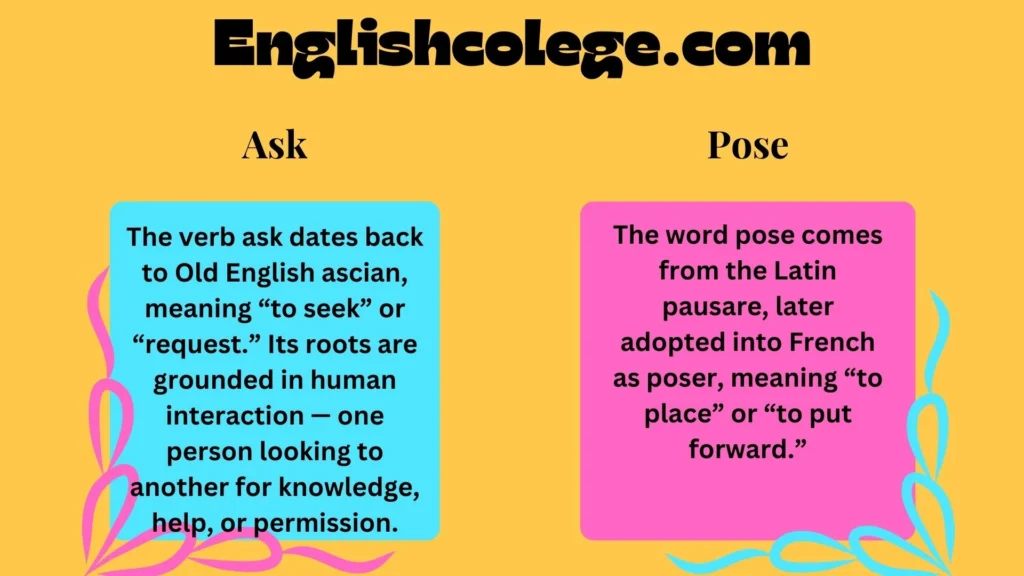
The verb ask dates back to Old English ascian, meaning “to seek” or “request.” Its roots are grounded in human interaction — one person looking to another for knowledge, help, or permission.
Key Features of “Ask”
- Purpose: To get information, permission, or action.
- Tone: Direct, personal, and conversational.
- Common Forms:
- Ask someone something → “I asked him a question.”
- Ask for something → “She asked for directions.”
- Ask about something → “He asked about your trip.”
Examples of “Ask” in Daily Life
- “Can I ask you something personal?”
- “They asked how long it would take.”
- “Ask for help if you’re unsure.”
- “I asked the teacher to explain again.”
These are straightforward, human-centered interactions — you’re looking for a response or action.
The Meaning of “Pose”
The word pose comes from the Latin pausare, later adopted into French as poser, meaning “to place” or “to put forward.” That’s exactly what happens when you pose a question — you put it out there for others to think about.
Key Features of “Pose”
- Purpose: To raise an issue, idea, or challenge.
- Tone: Formal, intellectual, reflective.
- Common Pairings:
- Pose a question
- Pose a problem
- Pose a challenge
- Pose a threat
Examples of “Pose” in Context
- “The journalist posed a difficult question about policy.”
- “This situation poses a risk to our plan.”
- “The professor posed a philosophical question.”
When you pose something, you’re not demanding a quick answer. You’re encouraging thought, exploration, and deeper analysis.
Ask vs. Pose: The Key Differences
Let’s see their distinctions side by side.
| Aspect | Ask | Pose |
|---|---|---|
| Meaning | To request or inquire | To raise or present |
| Tone | Informal, conversational | Formal, intellectual |
| Purpose | To get an answer or response | To spark thought or discussion |
| Context | Everyday conversation, workplace | Academic, analytical, professional |
| Examples | “I asked her to help me.” | “He posed an interesting question.” |
In short:
👉 Ask = seeking an answer
👉 Pose = presenting an idea
When to Use “Ask”
You’ll use ask most often. It fits nearly every situation involving conversation, curiosity, or clarity.
Common Situations
- Everyday Communication
- “Can I ask you a quick favor?”
- “I asked what time dinner starts.”
- Professional Settings
- “She asked the client for more details.”
- “He asked during the meeting if we could extend the deadline.”
- Learning and Feedback
- “Ask questions when you don’t understand.”
- “The coach asked for honest opinions.”
Why “Ask” Works
- It sounds natural and personal.
- It fits both formal and informal tones.
- It encourages direct engagement.
Psychological Insight
Research on communication shows that direct questions build trust. People who ask clear, specific questions are often seen as confident and approachable. That’s why leaders, teachers, and interviewers rely on “asking” — it keeps the interaction open and human.
When to Use “Pose”
Use pose when you want to introduce a thought, challenge an assumption, or start an intellectual discussion.
Common Situations
- Academic and Research Writing
- “The paper poses an essential question about global ethics.”
- “This theory poses a contradiction in logic.”
- Analytical or Philosophical Discussions
- “The philosopher posed a question about free will.”
- “That story poses a moral dilemma.”
- Formal Communication
- “The report poses a significant risk to investors.”
Why “Pose” Stands Out
- It adds sophistication to your tone.
- It fits abstract, conceptual, or academic topics.
- It’s often used to set up discussion rather than demand an answer.
Quick Tip
Avoid using pose in casual speech like “He posed me a question.” It sounds unnatural. Instead, say, “He asked me a question.” Reserve pose for contexts that need intellectual or reflective weight.
Nuances and Overlaps Between “Ask” and “Pose”
Sometimes, both words work — but they subtly change meaning.
| Sentence with “Ask” | Sentence with “Pose” | Tone Difference |
|---|---|---|
| “She asked a question about the meaning of life.” | “She posed a question about the meaning of life.” | “Ask” sounds curious; “pose” sounds philosophical. |
| “He asked about the report.” | “He posed a question about the report.” | “Ask” = wants details; “pose” = sparks analysis. |
Tone and Intent Matter
- Ask focuses on getting an answer.
- Pose focuses on exploring an idea.
Example:
If you’re interviewing someone, you ask them questions.
If you’re writing a research paper, you pose a question to guide your argument.
Case Study: Two Different Contexts
1. The Journalist
During a press conference, a journalist might say:
“I asked the minister about the new tax policy.”
That’s a direct question — the goal is to get an answer.
But in the article later, the journalist might write:
“This situation poses serious questions about government transparency.”
Now, the tone shifts to analysis. The focus isn’t on getting a reply but on encouraging readers to think.
2. The Teacher
In class, a teacher could say:
“Ask me if anything is unclear.”
That’s interactive and personal.
Later, while designing a test or essay topic, the teacher might pose a question:
“Pose a question that challenges students to think critically.”
This shows how one word choice changes tone, setting, and purpose.
Practical Tips for Choosing Between “Ask” and “Pose”
Here’s how to decide which word fits your sentence best:
Decision Guide
| Goal | Right Verb | Example |
|---|---|---|
| You want an answer, info, or help | Ask | “Ask your manager for feedback.” |
| You want to introduce an idea or issue | Pose | “The speaker posed a question about innovation.” |
Quick Editing Checklist
- Replace pose with ask in casual writing or dialogue.
- Use pose only when your goal is reflection or analysis.
- Read it aloud — does it sound natural? If not, it’s probably ask.
Tone Tip
👉 Ask connects you with your audience.
👉 Pose positions you as thoughtful and reflective.
Use both wisely depending on your communication goal.
Real-Life Writing Examples
In an Email:
❌ “I’m posing a question about the deadline.”
✅ “I’m asking about the deadline.”
In an Academic Paper:
✅ “This study poses critical questions about social responsibility.”
In Journalism:
✅ “The article poses new questions about privacy laws.”
In Conversation:
✅ “Can I ask you something?”
In Debate:
✅ “He posed a question that made everyone rethink their stance.”
Each fits its context. Mixing them up can sound awkward or overly formal.
Language Insight: Why Writers Care About Precision
Good writers don’t just write; they choose words. The difference between ask and pose shows how subtle vocabulary choices can shift perception.
Here’s a quote from linguist Steven Pinker that sums it up:
“Words are not just labels for things; they are tools for shaping thought.”
When you use ask, you create a bridge between people.
When you use pose, you challenge minds.
That’s the beauty of English — precision carries power.
Related Language Comparisons
If you enjoyed learning about ask vs. pose, here are other pairs that confuse writers:
| Word Pair | Key Difference |
|---|---|
| Mucus vs. Mucous | Mucus is the substance; mucous is the adjective. |
| Proceed vs. Precede | Proceed means go forward; Precede means come before. |
| Irregardless vs. Regardless | Irregardless is nonstandard; use regardless. |
| Are vs. Our | Are = verb “to be”; Our = shows possession. |
| Affect vs. Effect | Affect = verb (influence); Effect = noun (result). |
Language mastery often comes from spotting these fine distinctions.
FAQs About “Ask” vs. “Pose”
What does “pose a question” mean exactly?
It means to present a question for others to think about, not necessarily to get a direct answer. It’s often used in academic or analytical contexts.
Can you say “pose me a question”?
No, that’s grammatically awkward. Use “ask me a question.” You pose a question, but you ask someone a question.
Is “pose” more formal than “ask”?
Yes. Pose is more formal and usually appears in writing, journalism, or academic discussion, while ask is used in everyday speech.
Can “pose” sound pretentious?
It can, if used in casual conversation. Saying “She posed a question at dinner” might sound stiff. “She asked a question” fits better.
Can “ask” and “pose” ever mean the same thing?
Sometimes, yes. But even when both are correct, pose usually implies a reflective or challenging tone, while ask implies curiosity or need for information.
Conclusion
The difference between asking and posing isn’t just grammar — it’s about intent.
- You ask when you want answers, clarity, or action.
- You pose when you want reflection, discussion, or insight.
Whether you’re speaking, writing, or debating, the word you choose shapes how your message is received. So next time you find yourself about to ask or pose a question, think about your goal. Are you seeking information or sparking thought?
Mastering that subtlety makes your language more precise — and your communication more powerful.
