
Ever found yourself wondering whether to say “a five-year-old child” or “a five years old child”? You’re not alone. Even native English speakers stumble on this one.
Let’s clear the confusion once and for all. By the end of this guide, you’ll know exactly when to use “year old” and when “years old” fits right — and why that tiny hyphen matters more than you might think.
Understanding Why ‘Year Old’ vs. ‘Years Old’ Causes Confusion
At first glance, both phrases look almost identical. After all, the difference is just an “s” and sometimes a hyphen. Yet, that tiny difference completely changes the grammatical role of the phrase.
Here’s the core issue:
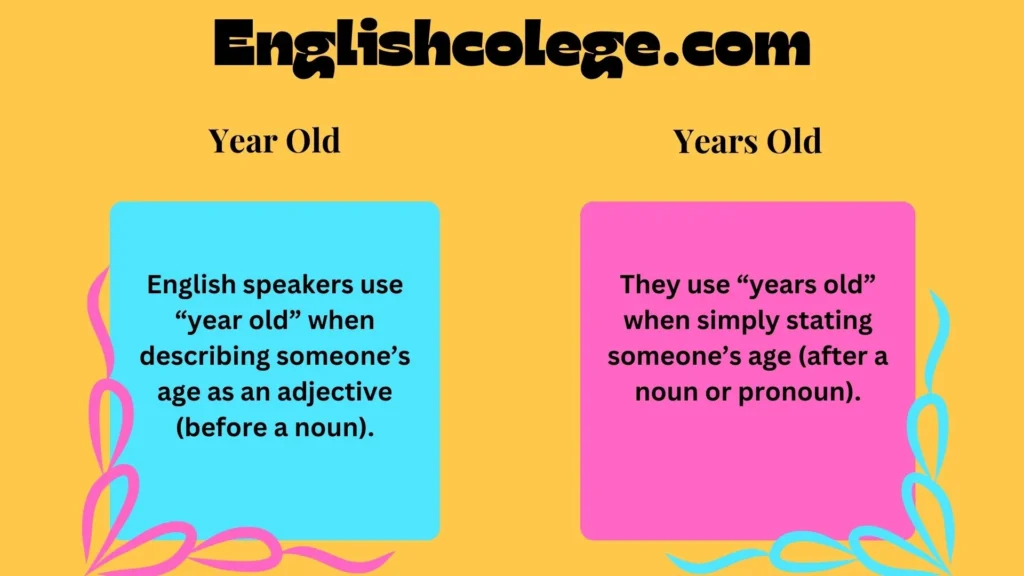
- English speakers use “year old” when describing someone’s age as an adjective (before a noun).
- They use “years old” when simply stating someone’s age (after a noun or pronoun).
But why? The answer lies in grammar rules — specifically compound adjectives and plural nouns.
Grammar Basics: The Structure Behind ‘Year Old’ and ‘Years Old’
Before diving deeper, let’s quickly break down the parts of speech involved:
| Word | Function | Example |
|---|---|---|
| Year / Years | Noun (shows time or duration) | “Five years is a long time.” |
| Old | Adjective (describes age) | “He’s old enough to drive.” |
When we combine them — “year old” or “years old” — they describe age. The form changes depending on where it appears in the sentence.
So, the trick is understanding position and function:
- Before a noun = use year old (singular, hyphenated)
- After a noun = use years old (plural, no hyphen)
Let’s explore that further.
When to Use ‘Year Old’ (Hyphenated and Singular)
When you use age as an adjective before a noun, you need the singular “year” and a hyphen.
✅ Correct:
- A five-year-old child smiled at me.
- She adopted a two-year-old dog.
- They bought a ten-year-old car.
❌ Incorrect:
- A five-years-old child smiled at me.
- She adopted a two-years-old dog.
Even though the number is plural (five, ten), the word “year” stays singular because it’s part of a compound adjective.
Think of it as one single descriptive unit:
Five-year-old acts as a single adjective meaning “aged five years.”
Quick Grammar Tip:
If the age phrase comes before the noun, it always acts like a single adjective and gets a hyphen:
“A seven-year-old girl” = One girl aged seven years.
When to Use ‘Years Old’ (Plural, No Hyphen)
When you place the age after a noun or pronoun, use “years old.”
✅ Correct:
- The child is five years old.
- My car is ten years old.
- He’s twenty-one years old.
❌ Incorrect:
- The child is five year old.
- My car is ten-year-old.
In this structure, “years” is plural because it’s just functioning as a noun, not as part of a compound adjective.
The key difference? The verb “to be” (is/are/was/were) comes before it.
The Role of Hyphens in Age Descriptions
Hyphens are small, but they’re mighty in grammar. They create clarity when you join multiple words into a single descriptive phrase.
Without a hyphen, your sentence could read awkwardly or even change meaning.
Compare:
- A 5-year-old boy won the race. ✅
- A 5 year old boy won the race. ❌
- A boy who is 5 years old won the race. ✅
The first example uses the hyphenated compound adjective correctly. The second lacks clarity.
Why Hyphens Matter:
They bind the elements together to show they belong to one description:
“5-year-old” = one complete adjective modifying “boy.”
Style Guide Consensus on Hyphenation
Different writing authorities agree on this rule. Here’s a quick overview:
| Style Guide | Recommendation | Example |
|---|---|---|
| APA (7th Edition) | Hyphenate age terms before nouns | “A 3-year-old study participant” |
| Chicago Manual of Style (17th Ed.) | Same rule applies | “A 10-year-old girl” |
| MLA Style Center | Recommends hyphenation for clarity | “A 20-year-old student” |
So whether you’re writing an essay, a blog, or a resume, hyphenation is the standard when age comes before a noun.
When Hyphenation Is Not Needed
Hyphenation drops when the phrase is not directly modifying a noun — meaning it comes after a verb.
✅ Correct:
- My cat is two years old.
- The athlete was only sixteen years old.
- They’re almost thirty years old.
In these sentences, “years old” acts as a predicate adjective, describing the subject but not attached directly to a noun.
No Hyphen Rule:
If the phrase stands after “is,” “are,” “was,” “were,” or “seems,” skip the hyphen.
Common Mistakes and How to Avoid Them
Let’s tackle the most frequent errors English learners (and even native speakers) make when talking about age.
Mistake 1: Pluralizing “Year” in Hyphenated Form
❌ She is a five-years-old girl.
✅ She is a five-year-old girl.
Fix: “Year” remains singular in compound adjectives.
Mistake 2: Forgetting the Hyphen
❌ A 6 year old child is adorable.
✅ A 6-year-old child is adorable.
Fix: Always hyphenate when it appears before a noun.
Mistake 3: Mixing the Two Structures
❌ He is a five years old boy.
✅ He is five years old.
✅ He is a five-year-old boy.
Fix: Use years old after the verb, or year old before the noun — never mix them.
Mini Reference Table
| Sentence Position | Correct Form | Example |
|---|---|---|
| Before a noun | year old (hyphenated, singular) | A 7-year-old boy |
| After a verb | years old (no hyphen, plural) | The boy is 7 years old |
How to Apply These Rules in Everyday Writing
You’ll find age expressions everywhere — in resumes, news stories, conversations, and biographies. Let’s see how these grammar rules work across contexts.
1. In Resumes or Bios
- A 30-year-old marketing expert with 10 years of experience.
- I’m 30 years old and passionate about digital storytelling.
2. In Journalism
- A 45-year-old scientist won the Nobel Prize in Physics.
- The victim, 45 years old, was found at the scene.
3. In Everyday Conversation
- My dog is three years old.
- I adopted a three-year-old beagle last week.
4. In Fiction Writing
Writers use both depending on tone:
“A nine-year-old boy peeked through the door.”
“The boy was nine years old, his eyes wide with curiosity.”
Quick Recap: ‘Year Old’ vs. ‘Years Old’ at a Glance
Here’s your ultimate cheat sheet:
| Usage Type | Correct Form | Example |
|---|---|---|
| Before noun (adjective) | year old (singular, hyphenated) | A 10-year-old child |
| After noun (predicate) | years old (plural, no hyphen) | The child is 10 years old |
| After linking verbs | years old | He seems 20 years old |
| Before nouns with ages | year old | A 100-year-old tree |
| Talking about time spans | years | The project took 3 years |
Memory Tip:
If you can insert a noun after it, use year old (with hyphen).
If it follows a verb, use years old.
Real-Life Case Study: Why Context Matters
Let’s test your understanding with a real-world example.
Case Study: Media Headlines
Compare these two headlines from real English-language publications:
- “Five-Year-Old Saves Toddler from Fire.”
- “Toddler, 2 Years Old, Survives House Fire.”
Both are grammatically correct — just different structures:
- Headline 1: Uses five-year-old before a noun (“saves toddler”) → needs hyphen.
- Headline 2: Uses years old after a noun (“toddler”) → no hyphen.
So, your choice depends purely on placement and grammatical role, not the number.
Expert Insight
“Ages behave like compound modifiers before a noun but stay plural when following verbs.”
— Dr. Susan Lane, Linguist & Grammar Expert
Language evolves, but grammar logic stays consistent. This is one of those timeless English structures every learner should master.
Common Variations and Edge Cases
Some age-related phrases break from the norm slightly — here’s how to handle them.
Using “Year-Old” Without Numbers
- A newborn baby (not “a zero-year-old baby”).
- An eighteen-year-old (noun phrase, meaning “person aged eighteen”). Example: “The eighteen-year-old won first place.”
Using “Old” Alone
- He’s old enough to vote.
- She’s getting older every year.
These drop “years” entirely and focus on degree of age, not the specific number.
Using “Aged” as a Replacement
“Aged” works well in formal writing or legal documents:
- A boy aged 12 = A 12-year-old boy
- Applicants aged 18 and over may apply.
Tip:
If “aged” fits naturally, the phrase probably uses years old in the informal form.
Related Grammar Guides to Deepen Your Understanding
Expand your grammar mastery with these similar articles:
- Listen to Music vs. Listen to the Music: Spot the Difference
- Continuous vs. Continual: Know the Subtle Distinction
- ‘Sale’ or ‘Sail’: Which One Do You Need?
- Collocate vs. Colocate – What’s the Real Difference?
- What Does Moratorium Mean? Explained with Examples
- Bombogenesis Meaning and Usage
- Two-Minute English: Fast Grammar Fixes
FAQs About ‘Year Old’ vs. ‘Years Old’
What’s the basic rule for using “year old” vs. “years old”?
Use “year old” before a noun with hyphens (e.g., a 5-year-old boy).
Use “years old” after a noun or verb (e.g., The boy is 5 years old).
Why is “year” singular in “five-year-old”?
Because it’s part of a compound adjective. The entire phrase “five-year-old” acts as one adjective describing the noun.
Do I always need a hyphen in “year-old”?
Only when it appears before a noun. Skip the hyphen when it’s after the noun (“He is five years old”).
Can “year-old” stand alone as a noun?
Yes! You can say “The three-year-old cried loudly” — here, “three-year-old” acts as a noun, meaning “child aged three.”
Is it correct to say “years of age”?
Yes, but it’s more formal. Example: “The applicant is 21 years of age.”
It’s equivalent to “The applicant is 21 years old.”
✅ Conclusion
Both “year old” and “years old” are correct — but only in the right context.
- Use year old (singular, hyphenated) before nouns.
- Use years old (plural, no hyphen) after verbs or nouns.
If you remember nothing else, remember this rule:
“Hyphenate before the noun. Pluralize after the noun.”
It’s simple, logical, and makes your English sound instantly more natural.
So next time you write, you won’t just sound correct — you’ll sound confident.
