
Language evolves with how we think, feel, and express who we are. Few words reflect this connection more powerfully than the difference between “myself” and “my self.” At first glance, they seem almost identical.
Yet a single space changes everything — from grammar to philosophy, from identity to intention.
This article dives deep into the real difference between “myself” and “my self”, explaining when to use each form and why it matters in both English grammar and self-expression.
Why This Confusion Exists
English learners — and even native speakers — often confuse myself and my self. It’s not hard to see why. Spoken aloud, they sound exactly the same.
But written, they carry distinct meanings:
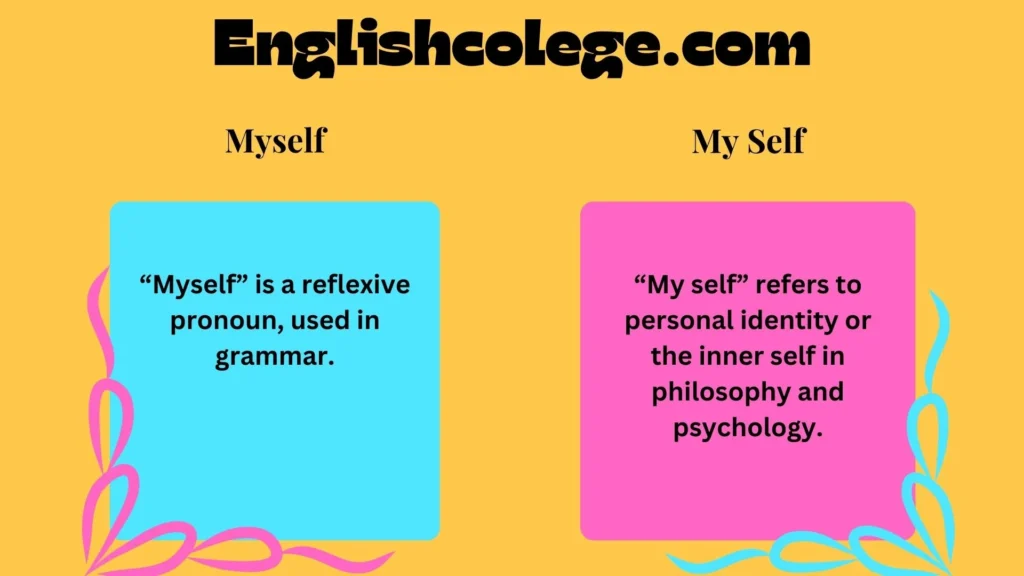
- “Myself” is a reflexive pronoun, used in grammar.
- “My self” refers to personal identity or the inner self in philosophy and psychology.
So, one speaks to language mechanics, the other to human essence. Understanding that difference helps you use each term with confidence — and even explore who you truly are.
Understanding “Myself”: The Reflexive Pronoun
In grammar, “myself” is one of the reflexive pronouns — words that reflect the subject back onto itself. Others include yourself, himself, herself, itself, ourselves, and themselves.
Definition
Myself is used when the subject and object of a sentence are the same person.
It reflects action back to the doer.
Example:
“I taught myself to play piano.”
(The subject I performs the action on myself.)
Two Main Functions of “Myself”
| Function | Explanation | Example |
|---|---|---|
| Reflexive | When the subject and object are the same | “I hurt myself.” |
| Emphatic | To emphasize the subject’s action | “I’ll handle it myself.” |
Let’s unpack these.
1. Reflexive Use
Used when someone performs an action on themselves.
Examples:
- I introduced myself to the class.
- She blamed herself for the mistake.
- We prepared ourselves for the exam.
2. Emphatic Use
Adds intensity or personal involvement.
Examples:
- I cooked this meal myself.
- The CEO approved it himself.
- They designed the logo themselves.
When to Use “Myself” — and When Not To
This is where many people slip up. “Myself” cannot replace “I” or “me” unless it’s reflexive or emphatic.
Common Errors
| Incorrect | Correct | Why |
|---|---|---|
| “John and myself went to the store.” | “John and I went to the store.” | “Myself” isn’t a subject. |
| “Please contact John or myself.” | “Please contact John or me.” | “Myself” isn’t an object here. |
Pro Tip:
If you can remove the other person and the sentence still makes sense, you’re safe.
✅ “I went to the store.”
❌ “Myself went to the store.”
Quick Grammar Guide
| Situation | Use “Myself”? | Example |
|---|---|---|
| Reflexive | ✅ | “I taught myself coding.” |
| Emphasis | ✅ | “I cleaned the car myself.” |
| Subject Pronoun | ❌ | “Myself will go.” |
| Object Pronoun | ❌ | “Give it to myself.” |
“My Self”: The Philosophical and Psychological Meaning
Unlike “myself,” “my self” isn’t a grammatical unit — it’s a noun phrase. Here, “my” acts as a possessive adjective, and “self” as a noun. Together, they describe the personal identity, character, or inner being of a person.
Definition
“My self” means my being, my inner essence, or the person I truly am beneath labels and roles.
Examples
- “I’m trying to reconnect with my self after years of stress.”
- “Meditation helped me understand my self better.”
- “My self is not the same as it was five years ago.”
Used In Psychology and Philosophy
Thinkers like Carl Jung and Sigmund Freud explored the Self as the center of consciousness.
In psychology, “self” represents:
- Self-concept: How you see yourself.
- Self-esteem: How you value yourself.
- Self-awareness: How aware you are of your thoughts and emotions.
Diagram: The Split Between “Myself” and “My Self”
                +----------------------------+
                |      THE HUMAN SELF        |
                +----------------------------+
                        /            \
                       /              \
              "Myself" (Grammar)   "My Self" (Identity)
             - Reflexive Pronoun   - Inner Consciousness
             - Used for Action     - Used for Reflection
             - Linguistic Tool     - Philosophical Concept
This diagram shows how language mirrors the mind — “myself” reflects physical action, while “my self” reflects mental or emotional being.
The Grammatical vs Existential Divide
The tiny space between “my” and “self” separates grammar from philosophy.
| Aspect | “Myself” | “My Self” |
|---|---|---|
| Type | Reflexive Pronoun | Possessive Adjective + Noun |
| Function | Reflects or emphasizes action | Refers to identity or selfhood |
| Context | Grammar, communication | Psychology, spirituality, introspection |
| Example | “I’ll do it myself.” | “I’m exploring my self through therapy.” |
That space changes everything.
Examples Comparing Both
| Sentence | Meaning |
|---|---|
| “I love myself.” | I care for my being. (Reflexive) |
| “I love my self.” | I value who I truly am. (Philosophical) |
| “I discovered myself on that trip.” | I experienced personal growth. |
| “I discovered my self on that trip.” | I uncovered my true identity. |
Quote to Remember:
“There’s a world of difference between talking to yourself and understanding your self.”
Historical and Literary Context
English hasn’t always treated these words the same way.
In Middle English and Early Modern English, writers often used “my self” as two words. Over time, as English grammar became standardized, “myself” merged into a single word.
Historical Notes
- Shakespeare used “my self” frequently in plays and sonnets. “I do betray my self with blushing.” — Othello
- In the 18th century, grammarians began treating reflexive pronouns (myself, yourself) as single lexical units.
- Modern English prefers “myself” for reflexive or emphatic purposes — while “my self” remains reserved for poetic, philosophical, or psychological writing.
Timeline Snapshot
| Era | Common Form | Usage |
|---|---|---|
| 1500s | “My self” | Standard usage |
| 1700s | “Myself” | Increasingly standardized |
| 1900s–Now | Both | Context-dependent meanings |
So when you see “my self” in older texts, it’s not a mistake — it’s history in motion.
Common Errors and How to Avoid Them
Here’s where even professional writers stumble.
Mistake 1: Using “Myself” as a Fancy Word for “Me”
❌ “Please send the file to John or myself.”
✅ “Please send the file to John or me.”
People often use “myself” thinking it sounds more polite or formal — but grammatically, it’s wrong unless reflexive.
Mistake 2: Forgetting the Philosophical Meaning of “My Self”
“My self” isn’t interchangeable with “myself.” It’s not just grammar — it’s identity.
Example:
- “I’m learning about myself.” → Self-discovery process.
- “I’m learning about my self.” → Exploring your psychological or spiritual identity.
Memory Trick
| Context | Ask This Question | Correct Form |
|---|---|---|
| Grammar | “Am I doing something to me?” | Myself |
| Philosophy | “Am I describing who I am?” | My self |
Quick recap:
- Use myself for grammar and emphasis.
- Use my self for identity, introspection, and self-awareness.
“Myselves” and Other Misconceptions
Let’s clear this up — “myselves” doesn’t exist in English.
Reflexive pronouns don’t take plural forms except those built into the language structure, such as ourselves or themselves.
Why Not “Myselves”?
Because reflexive pronouns must match the number and person of their subjects.
Example:
- Singular → “I see myself.”
- Plural → “We see ourselves.”
If you’re referring to different versions of yourself (as in psychology or art), you’d say:
“I’m exploring the many selves within me.”
Fun Fact
The plural selves exists but only as a noun, not a pronoun.
| Word | Grammatical Role | Example |
|---|---|---|
| Myself | Reflexive Pronoun | “I blamed myself.” |
| Selves | Noun (Plural) | “We have many selves — social, emotional, professional.” |
| Myselves | ❌ Incorrect | — |
Case Study: Language and Identity
A psychology researcher once asked participants to describe their “self” without using pronouns.
Most struggled at first but eventually defined themselves in terms of:
- Roles (“I’m a teacher.”)
- Traits (“I’m kind.”)
- Experiences (“I survived failure.”)
When language dropped reflexive grammar (“myself”), the focus shifted inward — to being rather than doing.
This illustrates how language shapes perception. “Myself” expresses function. “My self” expresses identity. Together, they show the full picture of being human.
Quick Quiz: Test Your Understanding
Choose the correct form — myself or my self.
- I often talk to ___ when I need motivation.
- I’m discovering ___ through meditation.
- I hurt ___ while lifting boxes.
- She reminded ___ to stay calm.
- I’m at peace with ___.
Answers:
- myself
- my self
- myself
- herself
- my self
FAQs
What is the main difference between “myself” and “my self”?
“Myself” is a reflexive pronoun used for grammar or emphasis. “My self” refers to your personal identity or consciousness — who you are beyond grammar.
Is “my self” grammatically correct?
Yes, when you mean your inner being or identity. It’s not a pronoun; it’s a possessive phrase (“my” + “self”).
Can I use “myself” in place of “I” or “me”?
No. That’s a common mistake. Use “I” for subjects and “me” for objects unless the sentence is reflexive or emphatic.
Why did old English texts use “my self” as two words?
Because reflexive pronouns hadn’t yet merged into single words. Over time, “myself” became standard for grammatical use, while “my self” stayed philosophical.
Is “myselves” a real word?
No. “Myselves” is incorrect. The correct plural reflexive form for “I” is “ourselves.”
Final Thoughts
Understanding the difference between “myself” and “my self” isn’t just grammar trivia — it’s a mirror of how language and identity intertwine.
- “Myself” shows action, responsibility, and emphasis.
- “My self” reveals reflection, awareness, and inner truth.
When you say, “I love myself,” you describe caring for who you are.
When you say, “I love my self,” you speak of honoring your inner being.
Both are correct — but each tells a different story about you.
Final Quote:
“Language doesn’t just describe us — it defines how we understand our selves.”

I’m Sameer — a passionate English enthusiast who loves exploring words, grammar, and the art of effective communication. ✍️