
When learning English, irregular verbs can trip you up—especially ones that look regular but aren’t. One of the most common offenders is “reset.” Many people wonder: Is the past tense of reset “reset” or “resetted”?
If you’ve ever paused mid-sentence, thinking, “Did I just say that right?”—this guide will clear up all confusion.
We’ll explore the correct usage, grammar rules, examples, and patterns behind this irregular verb, so you can speak and write with total confidence.
Understanding the Verb “Reset”
The verb “reset” means to set something again or to return it to its original state or condition.
You’ll often hear it in different contexts:
- Technology: “I reset my Wi-Fi router.”
- Psychology: “I need to reset my mindset after that tough day.”
- Fitness: “She reset her training plan after the injury.”
Grammatically, “reset” is an irregular verb. Unlike regular verbs that add -ed for the past tense (like played, jumped, or walked), irregular verbs break the rules.
“Reset” comes from the base verb “set”, which is also irregular.
So, let’s answer the big question.
The Correct Past Tense of “Reset”
The correct past tense of reset is reset — not resetted.
This means the word doesn’t change in any tense.
Let’s look at it in all three forms:
| Verb Form | Example Sentence |
|---|---|
| Base (Present) | I reset my alarm every night. |
| Past Tense | I reset my alarm last night. |
| Past Participle | I’ve reset my alarm several times this week. |
Notice something?
Each form looks identical, yet the meaning changes based on context.
That’s what makes reset an unchanging irregular verb—its spelling stays the same across all tenses.
Why It’s Not “Resetted”: Grammar Breakdown
Let’s get technical for a moment.
The verb “reset” follows the pattern of “set-family verbs”, which keep one form across all tenses. These verbs are considered uninflected irregular verbs—they don’t change even when used in past or past participle forms.
Here’s a simple table for clarity:
| Base Form | Past Tense | Past Participle |
|---|---|---|
| set | set | set |
| cut | cut | cut |
| put | put | put |
| shut | shut | shut |
| hit | hit | hit |
| reset | reset | reset |
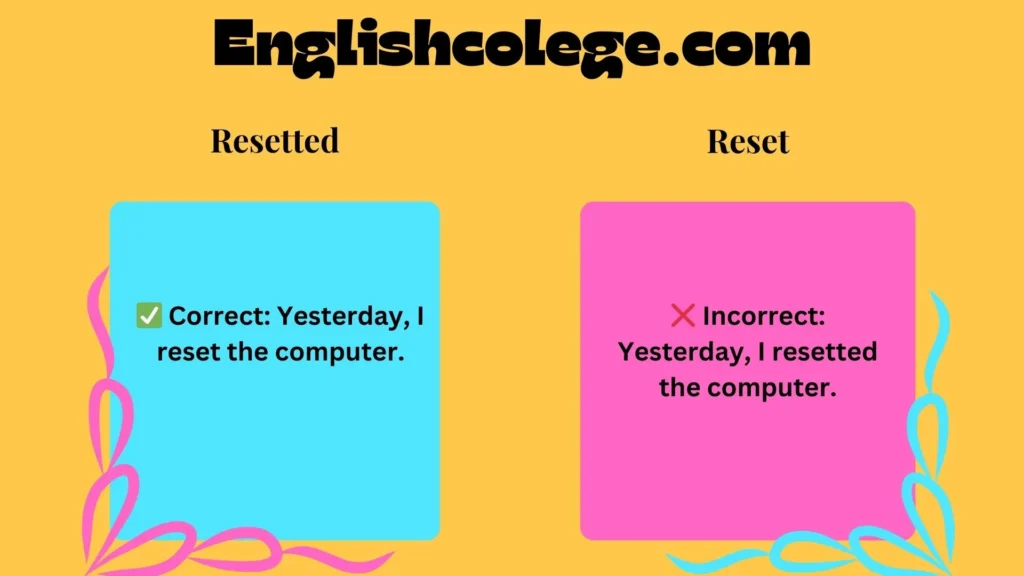
So, “resetted” doesn’t exist in standard English grammar. You’ll never see it in reputable dictionaries, grammar books, or native writing.
Example:
- ✅ Correct: Yesterday, I reset the computer.
- ❌ Incorrect: Yesterday, I resetted the computer.
Why?
Because “reset” already acts as its own past tense form. Adding “-ed” is grammatically redundant.
Pronunciation and Usage Across Tenses
You might wonder: if “reset” looks the same in all forms, how do you tell which tense it’s in?
The answer lies in context and time markers—not pronunciation.
Phonetically, “reset” is pronounced as:
/ˈriː.set/ (REE-set).
Let’s explore how it behaves across tenses:
- Present:
“I reset my phone every month.”
→ Habitual action. - Past:
“I reset my phone yesterday.”
→ Completed action. - Future:
“I’ll reset my phone tomorrow.”
→ Planned action.
Context words—like yesterday, today, or tomorrow—signal the tense.
Real-World Examples:
- “The coach reset the team’s strategy before the finals.”
- “Please reset your password to continue.”
- “She reset her emotional boundaries after the breakup.”
Each time, reset fits perfectly—without change.
Common Mistakes and How to Avoid Them
Even advanced learners sometimes write resetted because it feels natural—after all, most past tense verbs end in -ed. But reset is an exception.
Here are the most frequent mistakes:
❌ Mistake 1: Adding “-ed” to Irregular Verbs
“I resetted my laptop.”
Fix:
“I reset my laptop.”
❌ Mistake 2: Mixing up “did reset”
When using did (past tense auxiliary), the verb must return to its base form.
❌ “I did reseted my password.”
✅ “I did reset my password.”
❌ Mistake 3: Assuming Similar Verbs Behave the Same
Just because edited or restarted follow the -ed rule doesn’t mean reset does.
Tip: If a verb ends with “-set,” chances are its past form never changes.
Related Irregular Verbs to Remember
If you memorize one pattern, learning others becomes easier.
Here are some verbs that behave like “reset”:
| Verb | Past | Past Participle | Example |
|---|---|---|---|
| set | set | set | I set the table yesterday. |
| cut | cut | cut | He cut the paper neatly. |
| put | put | put | She put her phone away. |
| shut | shut | shut | They shut the door quietly. |
| hit | hit | hit | The ball hit the wall. |
| reset | reset | reset | I reset the timer twice. |
These are all one-form verbs, which makes them easier to master once you notice the pattern.
Practical Grammar Tips
To keep your grammar spotless, here are a few tried-and-true strategies:
- If it ends in “set,” don’t add -ed.
Examples: set, reset, offset, upset. - Use context clues.
Words like yesterday, last night, or tomorrow will tell the reader when the action happened. - Memorize irregular verb families.
Group them:- set/reset/upset
- cut/put/shut
- come/become/overcome
- Quick mnemonic:
“If you can set it, you can reset it — same rule, same form.”
Case Study: How “Reset” Appears in Real English
To show how English speakers actually use “reset,” let’s look at two examples from real-world contexts.
Case Study 1: Technology
“After the crash, the engineer reset the system.”
In this context, “reset” refers to restoring a device or system to default settings. Notice that although the action happened in the past, the word didn’t change.
Case Study 2: Personal Development
“After burnout, she reset her goals and priorities.”
Here, “reset” is used metaphorically—to represent a fresh start. Again, past tense, same form.
Key takeaway:
Regardless of context—literal or figurative—“reset” remains the same in every tense.
Expanding Your Grammar: Similar Irregular Verbs
To master irregular verbs, it helps to learn by patterns, not memorization alone.
Pattern 1: No Change Across Tenses
| Verb | Present | Past | Past Participle |
|---|---|---|---|
| set | set | set | set |
| reset | reset | reset | reset |
| cut | cut | cut | cut |
Pattern 2: Vowel Change Verbs
| Verb | Present | Past | Past Participle |
|---|---|---|---|
| begin | began | begun | |
| sing | sang | sung | |
| ring | rang | rung |
Pattern 3: Irregular with “-t” Ending
| Verb | Present | Past | Past Participle |
|---|---|---|---|
| build | built | built | |
| feel | felt | felt | |
| send | sent | sent |
Seeing patterns helps you anticipate how verbs behave rather than memorizing hundreds one by one.
Mini Quiz: Test Yourself
Fill in the blanks with the correct form of reset:
- I ______ my password yesterday.
- Have you ever ______ your smartwatch?
- Please ______ the timer before starting.
Answers:
- reset
- reset
- reset
Easy, right?
Common Learner Questions About “Reset”
What part of speech is “reset”?
“Reset” can be both a verb and a noun.
- Verb: Please reset your password.
- Noun: The system performed a reset.
Is “resetted” ever used informally?
Rarely, and only by mistake. It’s not recognized in standard English or by any major dictionary.
Is “reset” used in British and American English the same way?
Yes. Both dialects use “reset” as the past and past participle. The pronunciation and meaning are consistent.
Can “reset” be used in the continuous tense?
Yes, but with be + resetting.
Example: “The technician is resetting the router.”

Frequently Asked Questions (FAQs)
What’s the past tense of “reset”?
The past tense of “reset” is reset—it doesn’t change form.
Is “resetted” ever correct?
No. “Resetted” is incorrect in both spoken and written English.
How do you pronounce “reset” in the past tense?
It’s pronounced /ˈriː.set/—the same as in the present tense.
What type of verb is “reset”?
“Reset” is an irregular verb that remains unchanged in all tenses.
What are verbs similar to “reset”?
Other verbs with the same form include set, cut, put, hit, shut, and let.
Conclusion
So, here’s your ultimate rule: The past tense of reset is always “reset.”
Don’t overthink it. Whether you’re talking about restarting your computer, changing your mindset, or updating a machine, reset stays the same in every tense.
When in doubt, remember this:
“You can set it, and you can reset it—but you’ll never resetted it.”
Stick to that, and you’ll never second-guess this word again.
