
Organized crime has always fascinated and terrified society in equal measure. When people hear the words cartel or mafia, they often imagine dangerous men in suits, secret meetings, and violent power struggles.
Yet while these two terms are sometimes used interchangeably, the worlds they represent are profoundly different.
This guide dives deep into the real distinctions between cartels and mafias — from their origins and structures to their influence on politics, culture, and global crime today.
Beyond the Headlines: Understanding the Confusion
Both cartels and mafias operate outside the law, thrive on secrecy, and often control billion-dollar enterprises. But they differ in origin, organization, motivation, and cultural identity.
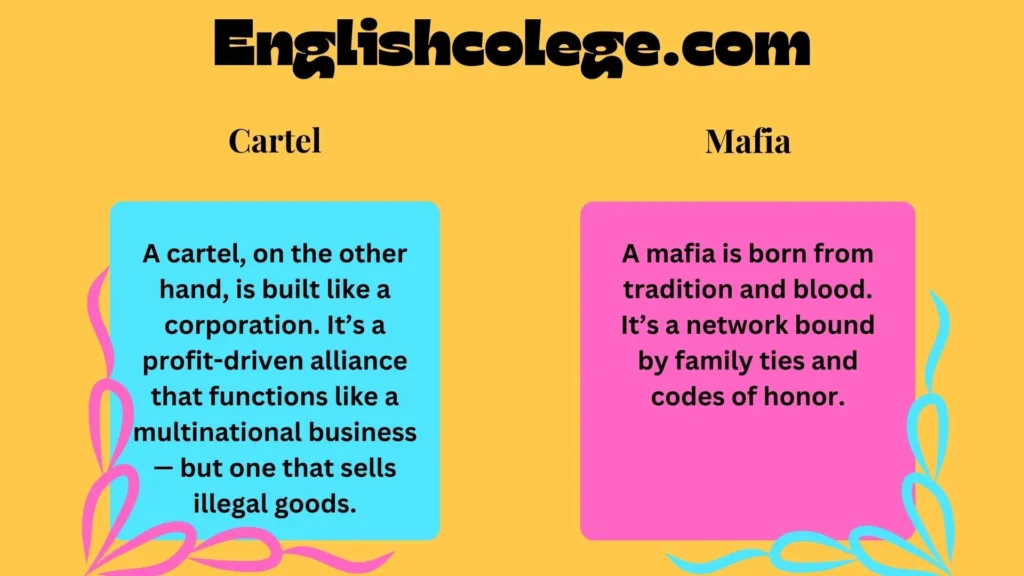
A mafia is born from tradition and blood. It’s a network bound by family ties and codes of honor.
A cartel, on the other hand, is built like a corporation. It’s a profit-driven alliance that functions like a multinational business — but one that sells illegal goods.
Let’s break down what each truly means.
What Is a Mafia?
The word mafia traces back to Sicily in the 19th century, from the Sicilian term mafiusu, meaning “bold” or “fearless.” Over time, it came to describe secret criminal brotherhoods operating under strict rules of loyalty and silence.
Key Traits of a Mafia
- Family-based hierarchy: Power flows through bloodlines and trust.
- Secrecy and initiation: Members take oaths under threat of death for betrayal.
- Code of conduct: Omertà, the vow of silence, forbids cooperation with authorities.
- Control through respect: Violence is calculated, not chaotic.
Examples of major mafias:
- Cosa Nostra (Sicily, Italy)
- Camorra (Naples, Italy)
- ’Ndrangheta (Calabria, Italy)
- La Cosa Nostra (United States branch of Sicilian Mafia)
These groups blend into society, manipulating politics, real estate, and legitimate businesses. They prefer quiet power to public terror.
What Is a Cartel?
Unlike mafias, cartels aren’t born from ancient traditions. The term comes from economics — meaning a coalition of businesses controlling prices and production. In organized crime, it refers to alliances of drug traffickers or crime bosses who cooperate to dominate markets.
Core Characteristics
- Profit-driven: Cartels exist purely to make money.
- Corporate-style leadership: They resemble multinational companies, complete with CEOs, accountants, and logistics managers.
- Extreme violence: Fear is their marketing strategy.
- Regional dominance: Cartels fight to control trade routes, especially in Latin America.
Examples of powerful cartels:
- Medellín Cartel (Colombia, led by Pablo Escobar)
- Sinaloa Cartel (Mexico, once led by Joaquín “El Chapo” Guzmán)
- Jalisco New Generation Cartel (CJNG) (Mexico)
- Cali Cartel (Colombia)
Cartels prioritize territory and volume — controlling routes, ports, and borders like global corporations manage supply chains.
Historical Foundations: From Sicily to Latin America
The Mafia’s Birth in Sicily
In 19th-century Sicily, weak government control left rural communities vulnerable to bandits. Local families began offering protection in exchange for loyalty — a system that evolved into organized extortion.
When Sicilian immigrants arrived in the United States in the late 1800s, they brought this model with them. During Prohibition (1920–1933), the American Mafia rose to power, controlling bootleg liquor and gambling operations.
“Prohibition created the greatest opportunity for organized crime in American history,” notes criminologist James O. Finckenauer.
The Rise of the Cartel
By contrast, the cartel era began in the 1970s with the booming global drug trade. Colombian groups like Medellín and Cali controlled cocaine exports to the US and Europe. Later, Mexican cartels took over routes after Colombia’s downfall.
Today, cartels dominate not just cocaine but also fentanyl, methamphetamine, and human trafficking. Their power extends through corruption, bribery, and fear.
Organizational Structures: Bloodlines vs. Businesslines
The difference between mafias and cartels is most visible in their organizational DNA.
| Aspect | Mafia | Cartel |
|---|---|---|
| Structure | Family hierarchy | Corporate-style chain |
| Leadership | Boss (“Don”) and Underboss | Council or CEO-like leadership |
| Loyalty | Based on blood and ritual | Based on profit and power |
| Discipline | Honor and silence | Fear and violence |
| Violence | Strategic and quiet | Public and spectacular |
The Mafia Chain of Command
- Boss (Don): The supreme leader
- Underboss: Second-in-command, manages daily operations
- Caporegime: Mid-level managers commanding “crews”
- Soldiers: Core members handling business
- Associates: Non-members working with the mafia
The Cartel Model
- Leader or Kingpin: Controls the trade and strategic alliances
- Lieutenants: Oversee regions or product lines
- Enforcers: Handle discipline, assassinations, and threats
- Financial operatives: Launder money through shell companies
- Logistics networks: Manage smuggling routes and distribution
Cartels are flexible — they outsource operations and franchise their name. Mafias, in contrast, preserve strict hierarchies rooted in loyalty and secrecy.
Economic Models and Criminal Enterprises
How Mafias Make Money
Mafias prefer quiet control over local economies. Their income often comes from:
- Extortion and protection rackets
- Illegal gambling
- Loan sharking
- Construction and waste management
- Drug trafficking (later adopted from cartels)
Their approach mimics a shadow government. They offer “protection” where the state fails.
How Cartels Earn Billions
Cartels thrive in global markets, particularly drug production and smuggling. Major revenue sources include:
- Cocaine, heroin, meth, and fentanyl production
- Kidnapping and extortion
- Human and weapons trafficking
- Counterfeit goods
- Cybercrime and cryptocurrency laundering
In 2022, the Sinaloa Cartel alone was estimated to earn over $13 billion annually, rivaling mid-size global corporations.
Political Power and Corruption
Organized crime doesn’t just operate in the shadows — it infiltrates the very systems meant to stop it.
Mafia Tactics
Mafias use subtle corruption:
- Funding political campaigns
- Influencing law enforcement
- Penetrating legitimate businesses
In Italy, investigations revealed deep ties between politicians and criminal clans. The Mafia Capitale scandal (2014) exposed collusion between crime bosses and Rome officials in public contracts.
Cartel Control
Cartels, however, dominate through brute force and fear.
In Mexico, mayors, police chiefs, and even journalists are frequent targets.
Entire regions become “narco states”, where the cartel replaces the government.
“Plata o plomo” — silver or lead — captures the cartel mindset: take the bribe or take the bullet.
Culture, Identity, and Public Perception
The Mafia’s image is deeply tied to tradition. It’s a “family business,” built on heritage, loyalty, and codes. Mafia members often view themselves as men of honor, not criminals.
By contrast, cartels operate on terror and dominance. Their image revolves around fear, status, and control.
Cultural Myths
- Mafia: romanticized as “honorable criminals” in The Godfather
- Cartel: portrayed as ruthless and flashy in Narcos
Yet both mask horrific realities — kidnappings, murders, and systemic corruption.
The Hollywood Effect: How Media Shapes the Narrative
Movies and TV shows have shaped global perceptions of organized crime.
Mafia in Media
Films like The Godfather, Goodfellas, and The Sopranos painted mafias as complex, even noble, figures torn between loyalty and greed.
Cartels in Media
Series like Narcos, El Chapo, and Sicario show the brutal realism of cartel life — mass killings, political assassinations, and the human cost of drug wars.
While entertaining, these portrayals distort reality. They can glamorize violence, turning criminals into antiheroes.
Modern-Day Influence and Global Reach
Organized crime has evolved beyond local territories. Both mafias and cartels now operate globally through technology and finance.
Where Mafias Still Reign
- Italy (Sicily, Calabria, Naples)
- United States (New York, Chicago, Las Vegas)
- Russia (Solntsevskaya Bratva)
- Japan (Yakuza)
Where Cartels Dominate
- Mexico and Colombia
- Venezuela and Brazil
- Central America (Honduras, El Salvador)
- Expanding into Europe and Asia through synthetic drug trade
The Digital Shift
Both cartels and mafias now leverage:
- Cryptocurrency for laundering
- Encrypted messaging apps for coordination
- Dark web marketplaces for drug sales
The “cyber cartel” is a growing threat — combining old-world crime with modern technology.
Comparison Snapshot: Mafia vs. Cartel
| Aspect | Mafia | Cartel |
|---|---|---|
| Origin | Sicily, 1800s | Latin America, 1970s |
| Structure | Family-based hierarchy | Business-style network |
| Primary Activity | Extortion, gambling, smuggling | Drug trafficking, human trade |
| Loyalty Basis | Family and honor | Profit and power |
| Violence Type | Discreet and targeted | Public and brutal |
| Corruption Style | Subtle infiltration | Direct coercion |
| Public Image | Traditional, secretive | Violent, modern |
| Global Presence | Europe, US, Asia | Americas, global routes |
Case Studies: Real-World Power and Influence
Case Study 1: The Sicilian Mafia’s Political Web
In postwar Italy, Cosa Nostra infiltrated city councils, manipulated elections, and secured public contracts worth millions. Judges like Giovanni Falcone and Paolo Borsellino, who fought the Mafia, were assassinated in the early 1990s — shocking Italy and spurring anti-mafia reforms.
Case Study 2: The Rise and Fall of Pablo Escobar
The Medellín Cartel under Pablo Escobar controlled 80% of the world’s cocaine supply at its peak. Escobar’s fortune exceeded $30 billion (in today’s value). His downfall in 1993 marked the end of one era — but birthed smaller, more violent factions.
Case Study 3: The Modern Mexican Cartel War
Between 2006 and 2024, over 350,000 deaths were linked to Mexico’s drug wars. Rival cartels like Sinaloa and CJNG fight for dominance, using military-grade weapons and social media propaganda to display power.
FAQs: Cartel vs Mafia
What’s the main difference between a cartel and a mafia?
A mafia is family-based and bound by honor, while a cartel is business-oriented and driven by profit.
Are cartels more violent than mafias?
Generally yes. Cartels rely on public displays of violence to intimidate, while mafias prefer discreet enforcement.
Do mafias still exist today?
Absolutely. Italian and Russian mafias remain active in drug trafficking, extortion, and cybercrime.
Which is richer — cartels or mafias?
Modern cartels generate more revenue, with some earning billions annually from drug exports.
How do governments fight organized crime today?
Through international cooperation (Interpol, DEA, Europol), asset freezes, cyber tracking, and intelligence sharing.
Conclusion
Though they share methods of corruption, intimidation, and secrecy, mafias and cartels represent two distinct criminal ecosystems. One is rooted in old-world loyalty; the other thrives in global capitalism’s dark side.
Both adapt with time — from Sicily’s rural clans to Mexico’s digital empires — proving that organized crime evolves with society itself.
Understanding their differences isn’t just academic. It’s vital for tackling their global influence, protecting economies, and restoring communities scarred by their reach.
“Crime, like business, adapts to demand. And as long as demand exists, the supply will find a way.”
