
If you’ve ever paused mid-sentence wondering whether to write “most important” or “most importantly,” you’re not alone.
Even seasoned writers and editors debate over which one is grammatically correct or sounds more natural.
Let’s clear the confusion once and for all — without the jargon. Both phrases are correct, but they serve slightly different grammatical roles and tones.
Once you understand why, choosing between them becomes second nature.
The Grammar Core: Adjective vs. Adverb Explained Simply
English grammar often trips people up because the same idea can appear in multiple forms. The difference between “most important” and “most importantly” comes down to one classic grammar point — adjectives vs. adverbs.
Here’s the quick version:
| Phrase | Grammar Type | Function | Example |
|---|---|---|---|
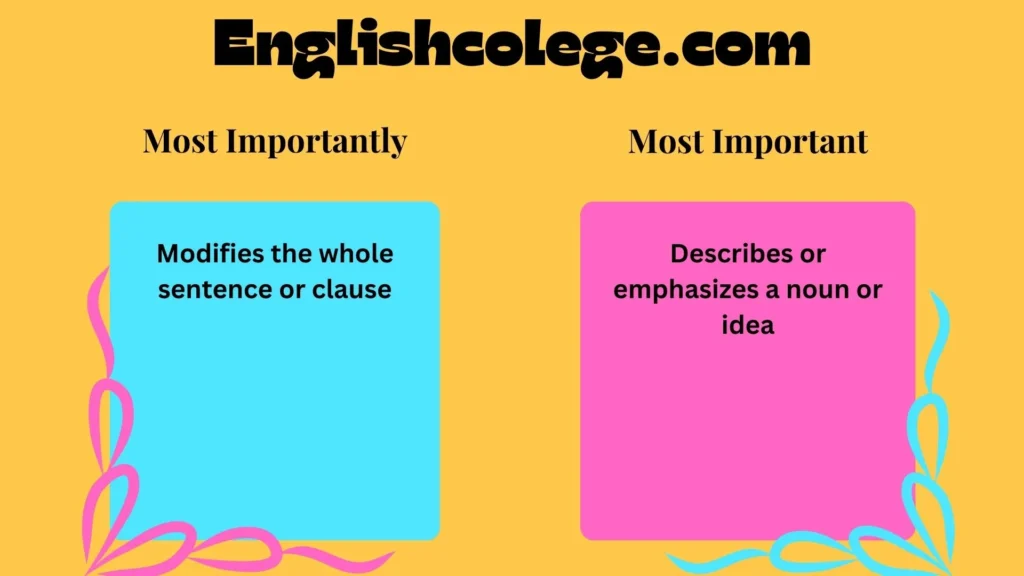
| Most important | Adjective phrase | Describes or emphasizes a noun or idea | “Most important, honesty builds trust.” |
| Most importantly | Adverb phrase | Modifies the whole sentence or clause | “Most importantly, honesty builds trust.” |
Adjectives describe things or ideas.
Adverbs describe how something is done — they often modify verbs or entire clauses.
So, “most important” is an adjective phrase, while “most importantly” acts as an adverbial connector — a way to smoothly lead into a statement or conclusion.
Think of it like this:
- “Most important” = focusing on what matters most.
- “Most importantly” = focusing on how you express what matters.
Both are grammatically correct, but their tone and rhythm differ slightly — one is direct, the other transitional.
The Historical Journey of Both Phrases
To understand how both forms evolved, it helps to look at their history in English usage.
- “Most important” appeared in written English as early as the 1700s in academic and political works.
- “Most importantly” gained ground during the 20th century, especially in spoken and journalistic English.
📈 Usage Over Time (Based on Google Ngram Data)
| Time Period | “Most Important” | “Most Importantly” |
|---|---|---|
| 1800–1850 | Very common | Rare |
| 1900–1950 | Dominant | Growing steadily |
| 2000–Present | Stable | Nearly equal in frequency |
The rise of “most importantly” reflects a broader trend: modern English has become more conversational and less rigid about grammar rules. What once sounded informal or “incorrect” now appears regularly in respected publications.
Grammar Authorities Weigh In
When grammar experts disagree, you know it’s worth digging into. Let’s look at what some of the most trusted linguistic sources say about this debate.
Merriam-Webster Dictionary:
“Both most important and most importantly are widely used and accepted. The difference lies in stylistic preference, not correctness.”
Garner’s Modern English Usage:
“Most important is slightly more formal, while most importantly is more common in speech and informal writing.”
Oxford English Dictionary:
Notes that “most importantly” gained wide acceptance in modern usage, though “most important” remains common in academic contexts.
Fowler’s Modern English Usage (1926 edition):
“Strict grammarians prefer most important for conciseness, but most importantly has gained idiomatic legitimacy.”
In short, grammar authorities have relaxed over time. Both forms are now considered acceptable, provided they fit the tone and flow of your sentence.
Examples That Clarify the Difference
Let’s break it down with clear, side-by-side examples:
| Context | Correct Form | Example Sentence | Why It Works |
|---|---|---|---|
| Emphasizing a key point | Most important | “Most important, stay calm during an emergency.” | Adjective phrase introducing a crucial idea. |
| Expressing priority in a reflective way | Most importantly | “Most importantly, stay calm during an emergency.” | Adverbial phrase emphasizing the action. |
| Listing priorities | Most important | “Preparation is key, but most important is consistency.” | Modifies the noun “consistency.” |
| Adding a concluding emphasis | Most importantly | “Most importantly, remember why you started.” | Adds emotional and reflective tone. |
Pro tip:
If your sentence continues directly after the phrase (without a verb), “most important” often fits better.
If it starts a new clause or feels like a transition, “most importantly” usually sounds smoother.
Real-World Usage: What People Actually Say and Write
In actual writing and speech, context plays a bigger role than grammar theory.
🗞️ What the Data Says
- News Outlets: “Most importantly” appears more often in The New York Times and The Guardian because journalists use it to transition between ideas.
- Academic Journals: “Most important” is favored in scholarly writing due to its concise and formal tone.
- Social Media & Everyday Speech: “Most importantly” dominates because it sounds natural when spoken aloud.
Example from The Economist:
“Most importantly, global cooperation is essential for stability.”
Example from a Scientific Journal:
“Most important are the long-term effects of climate policy.”
Both are correct — but the tone differs. The first sounds reflective and smooth, while the second sounds assertive and structured.
Context Is King: Choosing the Right Form
Choosing between “most important” and “most importantly” depends on context, tone, and audience.
✅ When to Use “Most Important”
- When writing formal essays, reports, or research papers.
- When emphasizing a thing, idea, or concept.
- When you want your sentence to sound concise and direct.
Example:
“Most important, the study reveals a significant correlation between diet and mood.”
✅ When to Use “Most Importantly”
- When writing in a conversational or reflective tone.
- When connecting thoughts smoothly between paragraphs.
- When emphasizing the act of doing something or an overall statement.
Example:
“Most importantly, the results remind us to value long-term habits over quick fixes.”
What Modern Style Guides Recommend
Style guides no longer insist on choosing one over the other. Instead, they focus on clarity and consistency.
| Style Guide | Preference | Notes |
|---|---|---|
| APA (7th Edition) | Neutral | Accepts both forms depending on tone. |
| Chicago Manual of Style | Prefers “most important” in academic prose. | Considers “most importantly” acceptable for transitions. |
| Associated Press (AP) | Leans toward “most importantly” in journalism. | Reflects modern usage in media writing. |
| Garner’s Modern English Usage | Accepts both | Advises consistency throughout the document. |
✏️ Rule of Thumb
If you’re writing:
- Academic or technical content: use most important.
- Editorial or narrative writing: use most importantly.
- Conversational or personal writing: either works — go with what sounds natural.
Practical Tips for Writers and ESL Learners
For non-native speakers, this distinction can feel tricky at first. Here’s how to make it easy.
💡 Quick Tips
- Read your sentence out loud. If it sounds natural, it’s probably correct.
- Don’t overthink — both are correct, but context matters.
- Keep consistency throughout your piece. Mixing both can sound awkward.
- When in doubt, rewrite the sentence entirely for clarity.
- Instead of: “Most importantly, we must act now.”
- Try: “The most important thing is to act now.”
🧩 Common Mistakes
| Mistake | Why It’s Wrong | Corrected Version |
|---|---|---|
| “Most importantly thing is honesty.” | “Importantly” can’t modify a noun. | “The most important thing is honesty.” |
| “Most important, we must quickly.” | “Important” can’t modify a verb. | “Most importantly, we must act quickly.” |
Case Study: How Context Changes Tone
Let’s look at two real-world writing examples from professional publications.
Case Study 1: Academic Journal
“Most important are the implications for neural network design.”
- Used “most important” to emphasize the noun “implications.”
- Fits the formal, structured tone of academic research.
Case Study 2: Business Magazine
“Most importantly, the company’s culture fosters collaboration.”
- Used “most importantly” to introduce a key reflection.
- Creates a conversational, approachable feel.
Result:
Both convey the same meaning but evoke different tones. Academic writing values directness; business writing values flow and connection.
Final Thoughts
Language evolves. Grammar rules aren’t carved in stone — they adapt to how people communicate.
What matters most isn’t whether you say “most important” or “most importantly,” but whether your writing is clear, natural, and effective.
So next time you write, trust your ear. If it sounds right in context, it probably is.
Quick Recap:
- Both “most important” and “most importantly” are grammatically correct.
- “Most important” = adjective phrase → best for formal or academic tone.
- “Most importantly” = adverb phrase → best for transitions or conversational tone.
- Modern grammar experts approve both — clarity is key.
FAQs About “Most Importantly” vs. “Most Important”
Is “most importantly” grammatically correct?
Yes. It’s an adverbial phrase modifying a sentence or clause. It’s perfectly acceptable in modern English, especially in informal and conversational writing.
Which is more formal: “most important” or “most importantly”?
“Most important” sounds slightly more formal and academic, while “most importantly” feels conversational and natural in speech.
Can I use both in the same essay or article?
You can, but maintain consistency. Use one style throughout for smoother reading flow.
Is it wrong to start a sentence with “most importantly”?
Not at all. It’s common in both written and spoken English to use it as a transition or to emphasize a key point.
How can I decide which one to use quickly?
Use this test: if the phrase describes a thing → use “most important.” If it modifies the action or idea → use “most importantly.”

I’m Sameer — a passionate English enthusiast who loves exploring words, grammar, and the art of effective communication. ✍️