
Language is alive. It evolves, adapts, and carries traces of history in every word. Among its fascinating quirks lies a subtle confusion: “ourselves” vs “ourself.”
Both seem similar, yet their usage tells a story stretching from royal courts to modern grammar rules.
This guide will help you master their differences, understand when each applies, and learn how context shapes meaning.
Have you ever hesitated while writing a sentence like “We did it by ourselves” or wondered if “ourself” might sound more elegant? You’re not alone.
Both words stem from the reflexive pronoun family—words like myself, yourself, herself, and themselves. The difference lies in number and context.
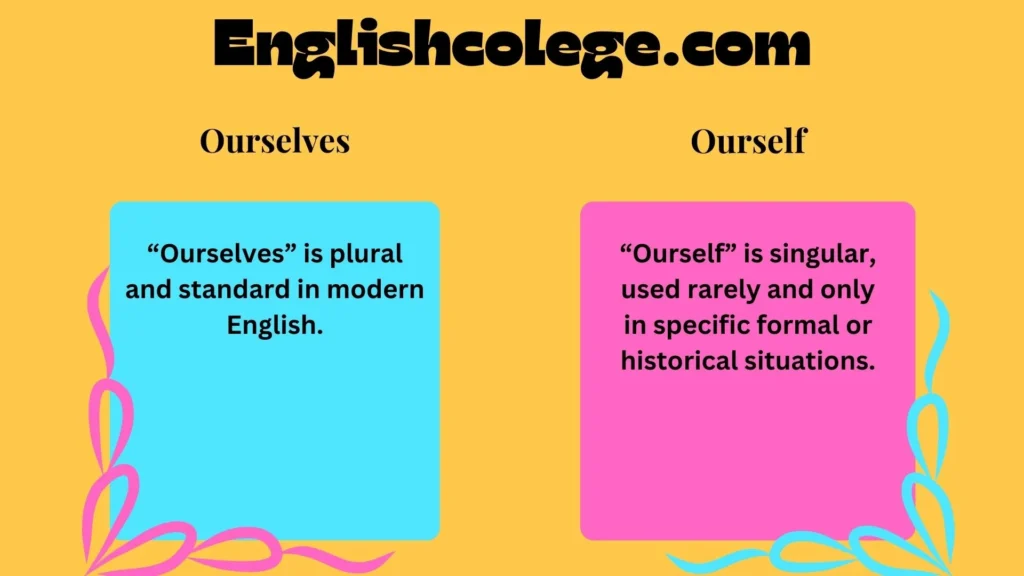
- “Ourselves” is plural and standard in modern English.
- “Ourself” is singular, used rarely and only in specific formal or historical situations.
Understanding this difference matters because using the wrong one can subtly change tone, meaning, or even sound awkward to native readers.
The Core Difference in Meaning
Let’s make the distinction crystal clear.
| Pronoun | Number | Function | Example | Modern Use |
|---|---|---|---|---|
| Ourselves | Plural | Reflexive of “we” | “We prepared ourselves for the exam.” | ✅ Common and correct |
| Ourself | Singular | Reflexive of “we” (royal/editorial) | “We, ourself, approve this decree.” | ⚠ Rare, formal, or archaic |
Key takeaway:
If you’re referring to a group, use ourselves.
If you’re representing a single person in a formal collective voice, ourself may apply—but only in special cases.
Historical Development of ‘Ourself’ and ‘Ourselves’
To understand why ourself even exists, we have to go back in time.
In Middle English (roughly 1150–1500), reflexive pronouns were not yet standardized. People said things like “we self” or “us self.” Over time, speakers added “-self” and “-selves” endings for clarity.
By the Early Modern English period (1500–1700), ourself was common in royal and formal speech. Monarchs often used we to refer to themselves, symbolizing the unity between ruler and realm. Thus, ourself became their natural reflexive counterpart.
Example from Shakespeare:
“We shall, ourself, in person, taste the griefs of death.” – King Lear
As English standardized, everyday speakers shifted toward plural agreement. That’s when ourselves took the lead, while ourself stayed behind in ceremonial use.
The Royal “We” and Its Link to ‘Ourself’
The royal we, or pluralis majestatis, is the most famous context where ourself survives today.
When monarchs or high officials speak, they often say “We declare,” instead of “I declare.” This form represents both the person and the institution they embody.
So, when the subject uses we to refer to one person, the reflexive pronoun becomes ourself.
Example:
“We, ourself, are deeply moved by the loyalty of our subjects.”
This is not arrogance—it’s linguistic tradition. It signals authority and unity between a sovereign and their office.
Modern usage: You’ll still find it in official documents or ceremonial speeches in the UK and other Commonwealth nations.
The Editorial and Institutional “We”
Beyond royalty, another group sometimes uses we in the singular sense—the editorial we.
Writers, academics, and journalists may say “We conclude that…” when referring to their own opinion or their organization’s stance.
However, here’s the difference:
- Editorial “we” is singular in spirit but plural in grammar.
- Therefore, it still uses ourselves, not ourself.
Correct: “We consider ourselves responsible for this analysis.”
Incorrect: “We consider ourself responsible for this analysis.”
Even in formal writing, ourself would sound outdated or pompous.
Correct Modern Usage: When to Use ‘Ourselves’
In today’s English, ourselves is the only reflexive pronoun accepted in everyday speech and writing.
Use ourselves when:
- The subject is plural (we).
- You’re describing an action done by the same group.
- You want to emphasize shared effort or reflection.
Examples:
- “We taught ourselves to play guitar.”
- “We congratulated ourselves on the victory.”
- “We should take care of ourselves.”
Common Mistakes to Avoid
❌ “We should take care of ourself.”
✅ “We should take care of ourselves.”
Remember: ourself doesn’t belong in normal plural contexts—it breaks grammatical agreement.
When ‘Ourself’ Still Appears (and Why It’s Rare)
Though nearly extinct in daily language, ourself remains alive in three special contexts:
- Royal and ceremonial speech: Used by monarchs, as seen earlier.
- Religious or literary tone: Sometimes used to add grandeur or solemnity.
- Historical or dialectal remnants: Certain Irish and British dialects preserve occasional use, such as “We’ll mind ourself, thank you.”
In all other cases, stick with ourselves.
Quick Reference Table
| Context | Preferred Pronoun | Example |
|---|---|---|
| Everyday speech | Ourselves | “We cooked dinner ourselves.” |
| Royal speech | Ourself | “We, ourself, will attend.” |
| Editorial writing | Ourselves | “We consider ourselves impartial.” |
| Historical text | Ourself | “We, ourself, bear witness.” |
Usage in Literature and Historical Texts
Writers have long used ourself and ourselves to reflect tone, perspective, or formality.
In Classic Literature
- Shakespeare: “We, ourself, will mingle with society.” (Coriolanus)
- King James Bible: “We have heard with our ears, O God; our fathers have told us.”
These uses weren’t errors—they followed the linguistic norms of their time.
In Modern Writing
Today, ourselves dominates because modern English favors clarity over ceremony. Even historical fiction writers use ourself only to evoke a specific tone or setting.
Tip: Unless you’re writing a royal proclamation or historical play, ourself rarely fits modern usage.
Common Misconceptions and Grammar Myths
Let’s clear up a few myths that confuse writers.
Myth 1: “Ourself” is incorrect.
→ Not true. It’s archaic, not incorrect—just limited in use.
Myth 2: Both are interchangeable.
→ Wrong. “Ourselves” fits plural subjects; “ourself” fits formal singular ones.
Myth 3: “Ourself” sounds more elegant.
→ Only if you’re wearing a crown. Otherwise, it sounds unnatural in everyday writing.
How to Remember the Difference
Here’s a simple trick:
If you’d say “we are,” use ourselves.
If you’d say “we are” but mean “I am” (royal/editorial), use ourself.
Mnemonics
- “We the people” → ourselves
- “We the monarch” → ourself
Diagram: Choosing the Right Form
Start → Are you one person?
      ↓ Yes → Speaking formally as “we”? → Use “ourself”
      ↓ No → Referring to a group? → Use “ourselves”
Practical Grammar Tips and Real-Life Examples
Quick Self-Check Questions
Ask these before writing:
- Is “we” referring to multiple people?
- Am I writing formally, ceremonially, or informally?
- Would “myself” make sense instead?
Examples:
| Scenario | Sentence | Correct Form |
|---|---|---|
| Group project | “We prepared ourselves for the presentation.” | ✅ Ourselves |
| Royal statement | “We, ourself, are pleased to announce.” | ✅ Ourself |
| Blog post | “We challenged ourselves to write daily.” | ✅ Ourselves |
Writing Tip
If you ever hesitate, 99% of the time, ourselves is your safest bet.
FAQs
What is the main difference between ourselves and ourself?
Ourselves is plural and standard; ourself is singular, used rarely in formal or royal contexts.
Is “ourself” grammatically incorrect?
Not incorrect, just archaic. It’s used only in specific formal speech or literature.
Can I use “ourself” in modern writing?
Only if you’re mimicking royal or historical language. Otherwise, stick with ourselves.
Why did English move from “ourself” to “ourselves”?
Language evolved toward grammatical clarity—reflexive pronouns adopted plural agreement to avoid confusion.
How do I teach this difference to ESL students?
Use examples and a rule of thumb: plural “we” = “ourselves.” Reserve “ourself” for history or formality lessons.
Conclusion
When it comes to ourselves vs ourself, the rule is clear yet rooted in history.
- Use ourselves for all plural references—it’s correct, modern, and natural.
- Use ourself only when writing in a royal, formal, or historical context.
Language reflects culture, tradition, and time. Understanding these subtleties doesn’t just make you a better writer—it connects you to centuries of English evolution.
Final Example:
❌ “We congratulate ourself.”
✅ “We congratulate ourselves.”
Mastering these distinctions ensures your writing sounds both natural and precise.

I’m Sameer — a passionate English enthusiast who loves exploring words, grammar, and the art of effective communication. ✍️