
If you’ve ever written “resignate” in a sentence and paused, wondering if it looked odd—you’re not alone.
Many English speakers mix up resignate and resonate because they sound so similar. But here’s the truth: only one of them is correct.
This guide will clear up the confusion once and for all. You’ll learn which spelling is right, where the other came from, and how to use resonate correctly in your writing, speech, and storytelling.
The Confusion Explained: Why People Mix Up ‘Resignate’ and ‘Resonate’
English loves to trip people up with words that sound alike. Resignate is one of those ghost words—it looks believable but isn’t real.
Here’s why people often confuse the two:
- Phonetic similarity: Resignate sounds close to resonate, especially when said quickly.
- Root confusion: It seems related to “resign” or “designation,” so it feels plausible.
- Misheard usage: People sometimes mishear others using “resonate” and reproduce it incorrectly as “resignate.”
In speech, these mistakes might slide by unnoticed. But in writing, especially in professional settings, using resignate can make your work look careless.
💡 Quick Tip: If you can’t find a word in a reputable dictionary like Merriam-Webster or Oxford English Dictionary, it’s probably not a word you should use.
The Correct Word: What ‘Resonate’ Really Means
Let’s set the record straight. The correct word is resonate.
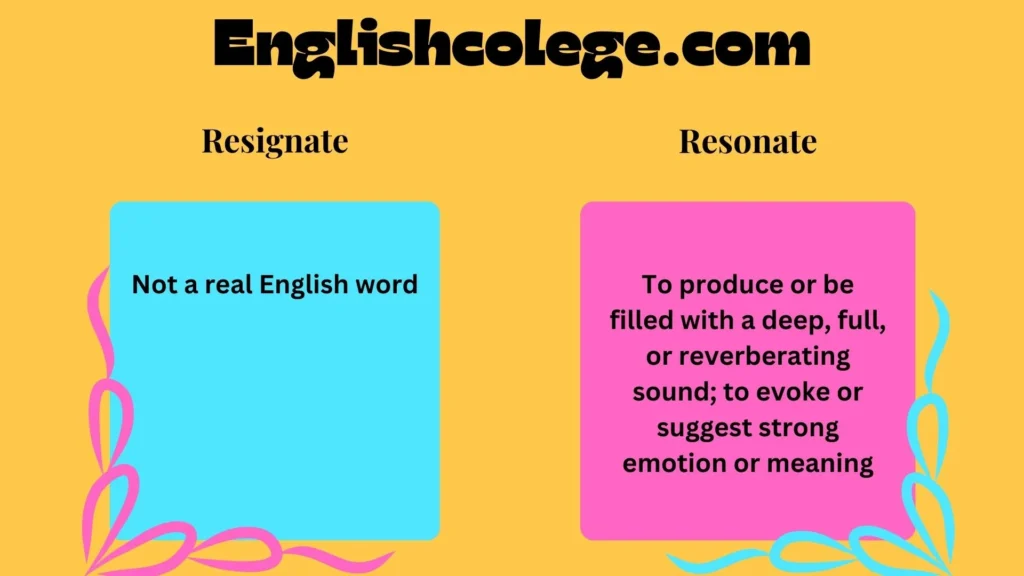
| Word | Part of Speech | Correct? | Meaning |
|---|---|---|---|
| Resignate | (pretend) verb | ❌ No | Not a real English word |
| Resonate | verb | ✅ Yes | To produce or be filled with a deep, full, or reverberating sound; to evoke or suggest strong emotion or meaning |
Real Definition
According to Merriam-Webster, resonate means:
“To produce or exhibit resonance,” or “to evoke a feeling of shared emotion or belief.”
Examples:
- The sound of the cello resonated through the hall.
- Her words resonated with the audience.
- That song resonates with my childhood memories.
In all these examples, resonate implies a deep connection—whether through sound or feeling. That’s what gives it power in both language and emotion.
Why ‘Resignate’ Isn’t a Word (And Why It Feels Like It Should Be)
So, if resignate isn’t real, how did it sneak into people’s vocabularies?
The Illusion of Legitimacy
It’s easy to see why resignate feels right. It sounds formal and fits the pattern of words ending in -ate like designate, resuscitate, or navigate. But it’s a linguistic mirage.
Historical and Regional Usage
No reputable dictionary has ever recorded resignate as a legitimate English word. A few isolated examples show up online or in older documents—but these are typographical errors, not recognized usage.
Why It Persists
The brain often “autocorrects” speech based on familiar patterns. Since resign and resonate both exist, people assume resignate must too. But linguists classify such words as nonstandard or erroneous formations.
Origin Story: The Etymology of ‘Resonate’
To understand resonate, it helps to trace its journey from Latin roots to modern English.
| Stage | Language | Word | Meaning |
|---|---|---|---|
| Ancient Latin | resonare | “to sound again” | re- (again) + sonare (to sound) |
| Middle English | resonaten | Adopted from Latin through Old French | |
| Modern English | resonate | “to echo, to vibrate, or to emotionally connect” |
This origin shows that resonate literally means “to sound again.” The idea of emotional resonance—something that “echoes” in your heart—comes from this same root concept.
Related Words:
- Sonar – from sonare, referring to sound waves used underwater
- Sonic – relating to sound or speed of sound
- Consonant – literally “sounding together”
🧠 Etymology Insight: Every time you say resonate, you’re echoing a piece of ancient Latin history that still vibrates in modern communication.
How to Use ‘Resonate’ Correctly
You can use resonate in two main ways—literally and metaphorically.
1. Literal Use (Sound or Vibration)
Used in science, music, or acoustics, resonate means to produce vibration or echo.
Examples:
- The cathedral’s walls resonated with the choir’s harmonies.
- Certain frequencies make glass resonate and even shatter.
2. Metaphorical Use (Emotion or Meaning)
In writing and speech, resonate often means “to connect deeply” or “to have emotional impact.”
Examples:
- His message resonated with young voters.
- The film’s theme of resilience resonated across generations.
3. Grammatical Forms
| Form | Example Sentence |
|---|---|
| Present | These words resonate with me. |
| Past | The story resonated for years after publication. |
| Present participle | Resonating messages build brand loyalty. |
| Noun (resonance) | Her speech had emotional resonance. |
✍️ Remember: Never write resignate in any form—it doesn’t exist. Always use resonate or its derivatives (resonating, resonated, resonance).
Common Mistakes to Avoid
Even advanced English users occasionally stumble here. Let’s clear up the most frequent errors.
| Incorrect | Correct | Explanation |
|---|---|---|
| Her words resignated with me. | Her words resonated with me. | “Resignate” isn’t a real word. |
| The sound resignates across the valley. | The sound resonates across the valley. | Use “resonates” for sound vibrations. |
| It had deep resignation with the audience. | It had deep resonance with the audience. | “Resonance,” not “resignation.” |
Quick Memory Trick
Think of “re-sonate” as sound again. That double “re” connection—re (again) + sonate (sound)—helps you remember the idea of echoing or emotional reflection.
‘Resonate’ in Culture and Communication
The word resonate appears everywhere—from political speeches to brand storytelling. It’s become one of the most powerful words in modern English because it implies connection.
In Marketing
Marketers use resonate to describe messages that emotionally connect with their target audience.
Example:
“Our campaign needs to resonate with Gen Z consumers.”
In Music and Film
Artists and filmmakers use resonate to describe works that stay with people long after they’ve finished experiencing them.
Example:
“That song resonated with listeners around the world.”
In Leadership and Public Speaking
Great communicators know that audiences don’t remember every word—but they remember what resonates emotionally.
Example:
“It’s not what you say—it’s what resonates.”
Quick Practice: Test Your Understanding
Try this short exercise to see if you’ve got it.
Fill-in-the-Blank Quiz
- The teacher’s message __________ with every student.
- The guitar string began to __________ when plucked.
- His speech deeply __________ with the crowd.
Answers:
- resonated
- resonate
- resonated
Sentence Rewrite Practice
Rewrite these sentences using the correct form of resonate.
| Incorrect Sentence | Corrected Version |
|---|---|
| The room resignated with laughter. | The room resonated with laughter. |
| Her ideas resignate with me. | Her ideas resonate with me. |
Case Study: Why Words That “Resonate” Build Trust
Consider how two brands communicate the same message:
| Brand A | Brand B |
|---|---|
| “We make eco-friendly shoes.” | “Our shoes resonate with those who care about the planet.” |
Brand B’s message connects on an emotional level. It uses resonate to evoke shared values, not just describe features.
That’s the power of using the right word—it creates empathy and memorability.
Famous Quotes Using ‘Resonate’
“Art should resonate with people, not just impress them.” — Unknown
“The best stories resonate because they reflect our own struggles.” — Maya Angelou (paraphrased insight)
“Music resonates when it speaks the truth of human emotion.” — Yo-Yo Ma
Each of these quotes highlights what resonate truly captures: emotional reflection that lingers.
Final Takeaway
If you’ve used resignate before, don’t worry—it’s a common mistake. But now you know the difference, you can use resonate with confidence.
Remember:
- Resignate ❌ — not a word
- Resonate ✅ — means to echo, vibrate, or emotionally connect
Words that resonate are the ones people remember. Choose them wisely, and your message will linger long after the conversation ends.
FAQs About “Resignate or Resonate”
What does “resonate” mean in simple terms?
It means something that connects deeply or echoes—either as sound or emotion.
Is “resignate” ever correct?
No. It’s not a recognized English word and doesn’t appear in any standard dictionary.
How do you use “resonate” in a sentence?
Example: The idea of freedom resonates with many people around the world.
What’s the noun form of “resonate”?
Resonance. Example: Her voice had a calm resonance.
How can I remember the correct spelling?
Think of sound—resonate comes from sonare, meaning “to sound.” If it’s about echoing or emotional impact, it’s resonate.
