
Language evolves fast, and English has its fair share of confusing word pairs. One of the most debated spelling choices is between “disfunction” and “dysfunction.”
You’ve probably seen both versions online, in articles, or even in academic writing. So which is correct? And why does the wrong one keep showing up?
Let’s dig deep into the origins, meanings, correct usage, and common mistakes behind these two forms — and finally settle the “disfunction vs. dysfunction” debate for good.
🌍 The Etymology: Where “Dysfunction” Comes From
The confusion starts with prefixes. English borrows many from Latin and Greek, and “dys-” is one such Greek prefix.
- “Dys-” means bad, difficult, or impaired.
- It appears in words like dyslexia (difficulty reading), dystopia (bad place), and dyspepsia (impaired digestion).
The full term “dysfunction” literally means abnormal or impaired function.
Quick Etymology Snapshot
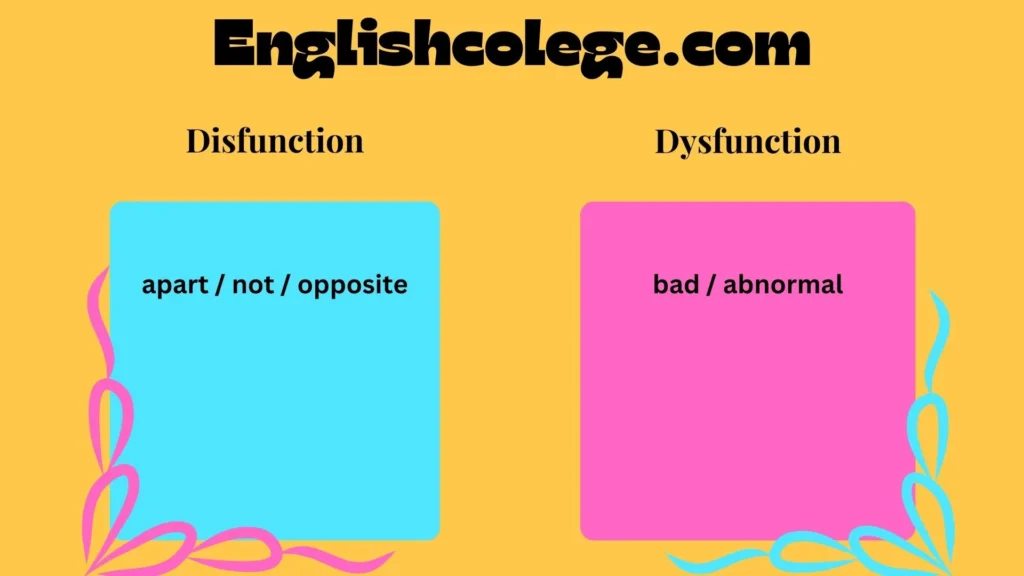
| Word | Prefix Origin | Meaning of Prefix | Overall Meaning |
|---|---|---|---|
| Dysfunction | Greek: dys- | bad / abnormal | Abnormal functioning |
| Disfunction | Latin: dis- | apart / not / opposite | ❌ Incorrect formation |
The prefix “dis-” in English means not or opposite of, as in disagree, disapprove, or dislike. So when people write “disfunction,” they’re unconsciously applying the wrong prefix pattern.
Quote: “Dysfunction isn’t about separation; it’s about impairment. That’s why the ‘dys-’ prefix fits perfectly.” — Linguist Marianne Hansen, Modern Word Studies Journal.
📚 “Dysfunction” — The Only Accepted Spelling
In modern English, only “dysfunction” is correct. It’s the form accepted by all major dictionaries, including:
- Merriam-Webster: “Impaired or abnormal functioning”
- Oxford English Dictionary (OED): “Abnormality or impairment in the function of an organ or system”
- Cambridge Dictionary: “The fact of something not working properly”
“Disfunction” may appear occasionally, but it’s marked as a common misspelling.
Examples of Correct Usage
- “The doctor diagnosed him with kidney dysfunction.”
- “The company’s organizational dysfunction led to miscommunication.”
- “Family dysfunction often roots in unresolved conflict.”
So, next time your spell-checker doesn’t flag “disfunction,” don’t assume it’s correct. Some older spell-check systems let it pass — but every modern English dictionary agrees: Dysfunction is the right word.
🧠 Why “Disfunction” Seems Logical — But Isn’t
It’s easy to understand why people make this mistake. The “dis-” prefix is familiar. You see it everywhere: dislike, disconnect, disappear. So naturally, you might think “disfunction” follows the same pattern.
However, the prefix “dys-” deals with malfunction or abnormality, while “dis-” refers to opposition or reversal.
Prefix Comparison Table
| Prefix | Meaning | Common Words | Used in “function”? | Example |
|---|---|---|---|---|
| dys- | bad / impaired / abnormal | dysfunction, dyslexia, dystrophy | ✅ Yes | “Dysfunction occurs when systems break down.” |
| dis- | not / opposite of / away | disconnect, disable, disprove | ❌ No | “Disfunction” is a spelling error. |
In short:
- Dysfunction = something doesn’t work properly
- Disfunction = doesn’t exist (error)
🩺 How “Dysfunction” Is Used in Modern English
The beauty of this word is that it crosses disciplines — from medicine to psychology and even workplace culture. Let’s break it down by context.
Medical Context
In medicine, “dysfunction” refers to impaired bodily function.
Examples:
- Erectile dysfunction – inability to maintain an erection.
- Liver dysfunction – abnormal liver performance.
- Immune dysfunction – weakened or overactive immune system.
In medical writing:
“Renal dysfunction was observed in 30% of patients post-surgery.”
The focus here is physical or biological malfunction — not an emotional or behavioral one.
Psychological and Social Context
In psychology or sociology, “dysfunction” often describes unhealthy relationships, families, or social systems.
Examples:
- “They grew up in a dysfunctional family environment.”
- “Workplace dysfunction” can mean poor leadership or communication.
- “Political dysfunction” describes systems that fail to operate effectively.
Case Study: The Dysfunctional Team
A 2022 leadership study by Harvard Business Review found that teams with unclear communication experienced 42% more reported dysfunction than those with defined roles and responsibilities.
The takeaway: dysfunction can affect any system — human or mechanical — where something doesn’t perform as expected.
🔍 “Dysfunction” vs. “Dysfunctional”
These two words look similar but serve different grammatical roles. Understanding their distinction helps you write precisely.
| Word | Part of Speech | Meaning | Example |
|---|---|---|---|
| Dysfunction | Noun | A problem or impairment in function | “Sleep dysfunction affects productivity.” |
| Dysfunctional | Adjective | Describes something that doesn’t work properly | “They’re a dysfunctional couple.” |
Quick Tip:
If you can put “a” or “the” before it — use dysfunction.
If you’re describing something — use dysfunctional.
Example:
- ❌ “He’s suffering from dysfunctional.”
- ✅ “He’s suffering from dysfunction.”
- ✅ “He’s part of a dysfunctional family.”
✏️ Grammar Focus: When and How to Use “Dysfunction”
“Dysfunction” is a countable and uncountable noun, depending on context.
Countable Example:
- “Different types of dysfunctions affect the heart.”
Uncountable Example:
- “Family dysfunction can last generations.”
Common Grammar Tips:
- Don’t pluralize unnecessarily — use “dysfunctions” only when talking about multiple specific types.
- Pair with descriptive modifiers — “neurological dysfunction,” “organizational dysfunction.”
- Avoid redundancy — never say “functional dysfunction.”
Examples in Sentences:
- “There’s growing dysfunction within the government.”
- “Emotional dysfunction often stems from unresolved trauma.”
- “Cardiac dysfunction was detected after the test.”
🚫 Correcting the Misuse of “Disfunction”
If you’ve been writing “disfunction”, don’t worry — it’s a common mistake. But here’s how to fix it:
Quick Correction Checklist
✅ Always double-check with credible dictionaries (Merriam-Webster, Cambridge, or OED).
✅ Use a grammar tool like Grammarly — it flags “disfunction.”
✅ Remember this trick:
“If it’s about difficulty or damage, it’s dys-, not dis-.”
Mnemonic
DYS = Doesn’t Yet Succeed — when something isn’t functioning properly.
DIS = Disconnects Intentionally — when something separates or opposes.
🧾 Quick Reference Guide
| Word | Correct? | Part of Speech | Meaning | Example |
|---|---|---|---|---|
| Dysfunction | ✅ Yes | Noun | Impaired or abnormal function | “The liver dysfunction was severe.” |
| Disfunction | ❌ No | — | Incorrect spelling | “Disfunction” should be “dysfunction.” |
| Dysfunctional | ✅ Yes | Adjective | Not working properly | “Their relationship was dysfunctional.” |
🔗 Related Language Tips
Here are other common English word confusions worth exploring:
- Cost or Costed – Which Is Correct?
- Schadenfreude – Meaning & Usage in English
- Cellar vs. Seller – Homophones Explained
- From My End or From My Side – Which Is Correct?
- Alma Mater – Meaning, Spelling & Capitalization
❓ FAQs About “Disfunction” vs. “Dysfunction”
What does dysfunction mean in simple terms?
It means something isn’t working properly. It can describe a body organ, a relationship, or even an organization.
Is “disfunction” ever acceptable in English?
No. “Disfunction” isn’t recognized by major dictionaries or grammar authorities. It’s considered a spelling mistake.
What’s the difference between dysfunction and malfunction?
“Malfunction” is often used for machines or systems, while “dysfunction” can describe both mechanical and emotional or social issues.
Can you use dysfunction in plural form?
Yes, but only when referring to multiple distinct issues, like “renal and hepatic dysfunctions.”
Is dysfunction formal or informal?
It’s neutral — common in both academic and everyday writing. You’ll see it in medical journals and casual articles alike.
🏁 Conclusion
When it comes to “Disfunction” vs. “Dysfunction,” the answer is crystal clear — “Dysfunction” is the correct and only accepted spelling.
It’s built from the Greek prefix “dys-,” meaning “bad” or “abnormal,” and it applies to any kind of impaired function — whether it’s physical, emotional, or systemic.
“Disfunction,” though tempting because of the familiar “dis-” prefix, simply doesn’t function in proper English.
Remember: “Dysfunction” means something isn’t working right. “Disfunction” means the spelling isn’t working right.
So, the next time you write about malfunctioning systems, failing organs, or chaotic families — make sure your word choice isn’t dysfunctional. 😉
