
Ever typed “unaccessible” only to see that annoying red underline pop up? You’re not alone. Many English learners and even native speakers get confused between unaccessible and inaccessible.
At first glance, both look right—but only one is grammatically correct and widely accepted.
This article unpacks everything you need to know about these two similar-looking words.
We’ll explore their history, usage, meanings, examples, and even when (if ever) you might use “unaccessible.” By the end, you’ll never mix them up again.
The Prefix Puzzle: Understanding “Un–” and “In–”
English prefixes shape meanings in powerful ways. When added to a base word, they can flip its meaning entirely.
Let’s look at the two prefixes in question: “un–” and “in–.”
| Prefix | Meaning | Common Usage | Example |
|---|---|---|---|
| un– | not, opposite of | Common with native English words | unhappy, unfair, unclear |
| in– | not, without | Common with words of Latin origin | inactive, invisible, incomplete |
The key difference lies in word origin.
- “Un–” usually pairs with words of Germanic or native English roots.
- “In–” typically attaches to Latin-based words.
Since “accessible” comes from Latin (accessibilis), the correct prefix is in–, forming inaccessible.
👉 Rule of thumb: When in doubt, check the root of the word. Latin-based words generally take in–, not un–.
The Etymology: Tracing the Origins
Understanding the word’s history makes everything click.
- Accessible comes from Latin accessibilis, derived from accessus (“approach” or “entrance”).
- During Middle English, many Latin-based terms entered English through French, bringing the in– prefix with them.
- Over time, inaccessible became standardized in dictionaries and literary works, while unaccessible slowly faded from use.
Fun fact: “Unaccessible” did exist in early English writings from the 1500s and 1600s but was gradually replaced by “inaccessible” as the language became more uniform.
Here’s how the evolution looked:
| Period | Common Form | Notes |
|---|---|---|
| 15th–16th century | unaccessible | Found in early English religious texts |
| 17th–18th century | inaccessible | Became standard form |
| 19th century onward | inaccessible | Fully standardized and dictionary-approved |
Quote from Oxford English Dictionary:
“Inaccessible has long been the established standard, while unaccessible remains an obsolete or dialectal form.”
Why “Inaccessible” Is the Correct Form
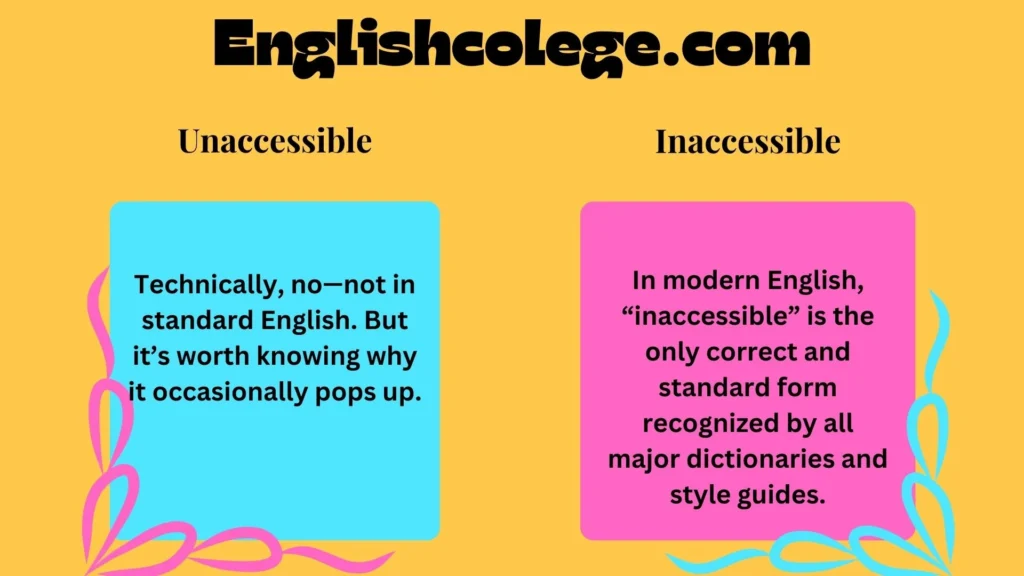
In modern English, “inaccessible” is the only correct and standard form recognized by all major dictionaries and style guides.
Here’s what top linguistic sources say:
| Source | Recognition | Comment |
|---|---|---|
| Merriam-Webster | ✅ Yes | “Inaccessible: not accessible.” No entry for “unaccessible.” |
| Oxford English Dictionary | ✅ Yes | Marks “unaccessible” as obsolete. |
| Cambridge Dictionary | ✅ Yes | Defines only “inaccessible.” |
| Collins Dictionary | ✅ Yes | Lists “unaccessible” as nonstandard. |
Linguistic logic:
“Accessible” comes from Latin, so by rule, the correct negative prefix is in–.
Words of Latin origin such as accurate, active, adequate, legal, and visible all take “in–” when negated:
- inaccurate
- inactive
- inadequate
- illegal
- invisible
Thus, inaccessible fits naturally into that family.
Corpus data (Google Ngram Viewer):
“Inaccessible” appears over 1,000 times more frequently than “unaccessible” in modern writing. The latter barely registers.
Is “Unaccessible” Ever Acceptable?
Technically, no—not in standard English. But it’s worth knowing why it occasionally pops up.
1. Historical Use
As mentioned earlier, “unaccessible” was used centuries ago before modern spelling rules solidified. It sometimes appeared in older British and religious texts.
Example (17th century):
“He dwelleth in unaccessible light.”
This form has since disappeared from contemporary writing.
2. Digital or Technical Errors
You might still see “unaccessible” online in error messages or software descriptions. For instance:
“This page is unaccessible.”
That’s not a deliberate linguistic choice—it’s usually a mistake by a non-native speaker or a developer’s typo.
3. Dialectal or Informal Usage
In rare dialects or colloquial speech, people might say “unaccessible,” but it’s still considered incorrect in writing.
✅ Correct every time: “Inaccessible”
❌ Avoid: “Unaccessible” (even casually)
Regional and Dialectical Usage
Some English words vary by region—like color (US) vs. colour (UK). But not this one.
There’s no regional variation for “inaccessible.” Both American and British English agree: unaccessible is incorrect.
Major style guides like AP, Chicago, and Oxford all instruct writers to use inaccessible.
| Region | Standard Form | Notes |
|---|---|---|
| United States | inaccessible | Used in journalism, academia, and business |
| United Kingdom | inaccessible | Same standard; “unaccessible” marked as archaic |
| Australia/Canada | inaccessible | Follows UK/US consistency |
Meaning and Nuance of “Inaccessible”
“Inaccessible” simply means “not able to be reached, entered, or understood.”
But its meaning can shift slightly depending on context.
Here are the three main types of inaccessibility you’ll encounter:
| Type | Example | Explanation |
|---|---|---|
| Physical | “The mountain peak was inaccessible during winter.” | Something physically unreachable |
| Digital | “The website is inaccessible due to server issues.” | Not reachable through technology |
| Intellectual or Emotional | “Her research is inaccessible to non-specialists.” | Difficult to understand or connect with emotionally |
So, inaccessible doesn’t always mean physically blocked. It can also describe things that are hard to grasp—mentally, emotionally, or socially.
Real-World Usage Examples
Let’s make this concrete with examples showing both correct and incorrect usage.
| Context | Incorrect | Correct |
|---|---|---|
| Website error | The page is unaccessible. | The page is inaccessible. |
| Terrain | The trail became unaccessible after the landslide. | The trail became inaccessible after the landslide. |
| Academic text | The topic remains unaccessible to most students. | The topic remains inaccessible to most students. |
| Emotion | His attitude makes him unaccessible to his peers. | His attitude makes him inaccessible to his peers. |
Quick tip:
If your spell-checker underlines “unaccessible,” it’s not being picky—it’s correct. Always replace it with “inaccessible.”
Guidelines for Correct Usage
When to use “inaccessible”:
- ✅ In academic writing
- ✅ In business or formal reports
- ✅ In journalism or blog posts
- ✅ In technical documentation
Even in casual writing, “inaccessible” sounds natural and correct. There’s no context where “unaccessible” fits better.
Style Tips
- Use inaccessible when referring to physical, digital, or abstract barriers.
- Avoid overusing it—swap with synonyms like unreachable or remote for variety.
- In accessibility contexts (like web design), prefer the term “inaccessible content” when describing pages that users can’t access due to design flaws.
Synonyms and Related Words
If you find yourself repeating inaccessible, mix it up with these synonyms depending on context:
| Meaning | Synonym | Example Sentence |
|---|---|---|
| Physically unreachable | remote | The cabin was remote and hard to reach. |
| Impossible to approach | unreachable | The summit was unreachable by foot. |
| Difficult to understand | obscure | The poet’s language was obscure to modern readers. |
| Emotionally distant | aloof | He remained aloof and inaccessible to fans. |
| Not usable | unavailable | The data was unavailable due to security restrictions. |
How to Choose the Right Synonym
- Physical spaces: remote, unreachable
- Digital spaces: unavailable, offline
- Abstract ideas: obscure, complex
- People or emotions: aloof, distant
Pro Tip: Choose the synonym that best captures why something can’t be accessed—distance, complexity, or restriction.
Related Confusing Word Pairs
English is full of subtle pairs that sound similar but mean different things. Here are some you might also like to explore:
- Wink vs. Blink – What’s the Difference?
- See vs. Look vs. Watch – When to Use Each
- Reef vs. Wreath – Common Spelling Mix-Up
- Present vs. Presents – Grammar & Meaning Explained
- Much Appreciated – Meaning, Synonyms, and Usage
- 15 Other Ways to Say “As a Result” – Enrich Your Writing
Cross-linking between these helps improve both understanding and vocabulary.
Quick Recap: Key Takeaways
Before we wrap up, here’s a summary table of everything we’ve covered:
| Point | Summary |
|---|---|
| ✅ Correct form | Inaccessible |
| ❌ Incorrect form | Unaccessible |
| Prefix rule | Latin roots take “in–,” not “un–.” |
| Meaning | Not reachable, enterable, or understandable |
| Common uses | Physical, digital, emotional contexts |
| Synonyms | Remote, unreachable, obscure, aloof |
| Style guides | All prefer “inaccessible” |
| “Unaccessible” today | Archaic or incorrect |
“Precision in language reflects clarity in thought.”
— Anonymous Linguist
Case Study: Accessibility in the Digital World
To see how this word matters in real life, consider web accessibility.
- When a website is poorly designed for people with disabilities, it becomes inaccessible.
- For example, if buttons aren’t labeled for screen readers or color contrast is too low, visually impaired users can’t navigate it.
According to the World Wide Web Consortium (W3C), over 97% of websites fail basic accessibility tests. That means they’re literally inaccessible to millions of users.
Lesson: Knowing and using the right term matters not just grammatically—but socially and ethically too.
FAQs
Is “unaccessible” ever grammatically correct?
No. “Unaccessible” is an outdated or incorrect form. Always use “inaccessible.”
Why do some people still use “unaccessible”?
Mostly due to confusion or typo errors. It occasionally appears in old literature or technical text but isn’t accepted today.
Can “inaccessible” describe people?
Yes! You can say, “He’s emotionally inaccessible,” meaning hard to approach or open up.
What’s a good synonym for “inaccessible” in technology?
Use unavailable or restricted depending on context—for example, “The server is unavailable.”
Is “inaccessibility” a word?
Yes. It’s the noun form meaning the state of being inaccessible. Example: “The inaccessibility of the region hindered rescue efforts.”
Conclusion
Language evolves, but precision never goes out of style. Between unaccessible and inaccessible, there’s only one winner.
Inaccessible is the correct, accepted, and standard form. It aligns with word origin, grammatical logic, and global usage. Using it correctly not only improves your writing accuracy but also your credibility.
Next time your spell-checker flags “unaccessible,” thank it—it’s saving you from a linguistic faux pas.
In summary:
Always write inaccessible, never unaccessible—unless you’re quoting Shakespeare.

I’m Sameer — a passionate English enthusiast who loves exploring words, grammar, and the art of effective communication. ✍️