
Language evolves like a living machine—every part has its purpose. But what happens when one small word becomes the “pin” holding together meaning, clarity, and communication itself? That’s exactly the case with “lynchpin” vs. “linchpin.”
You’ve probably seen both spellings. They look similar and sound identical. Yet one is technically correct, while the other lingers as a variant that confuses even seasoned writers.
This article breaks down their origins, definitions, usage trends, and grammatical standing, so you’ll never have to wonder again.
Let’s unlock this linguistic mystery.
What Is a Linchpin? The Core Meaning 🔧
At its simplest, a linchpin (also spelled lynchpin) refers to a pin that secures a wheel or other part on an axle. Without it, the wheel comes loose and the whole system collapses.
In other words, it’s small but absolutely essential.
Literal Definition
Linchpin (noun): a locking pin inserted through an axle to hold a wheel or machinery part in place.
You’ll find it in mechanics, engineering, and transport industries. But this humble metal fastener didn’t stay confined to machinery for long—it rolled its way into everyday speech.
Figurative Meaning
Over time, “linchpin” began representing anything—or anyone—crucial to keeping something together.
For example:
- “Teamwork is the linchpin of success.”
- “Trust is the linchpin of every lasting relationship.”
- “Innovation serves as the linchpin of modern technology.”
The metaphor is simple but powerful: just as a wheel falls off without its pin, a system fails without its key element.
Tracing the Word’s Roots: From Old English to Modern Usage 🕰️
Language history often explains modern confusion. The word linchpin dates back over 700 years, evolving from early English dialects.
| Period | Form | Origin/Influence | Notes |
|---|---|---|---|
| Old English | lyncis (axle tree) + pin | Germanic root | Referred to the bar or pin on a wagon wheel |
| Middle English (14th century) | lynspin or lynchpin | Phonetic spelling variations | Early spellings weren’t standardized |
| Modern English (17th century onward) | linchpin | Standardized spelling in mechanical texts | Became dominant in formal writing |
As spelling became standardized during the printing revolution, “linchpin” emerged as the accepted form.
However, “lynchpin” didn’t disappear—it simply lingered as a regional variant.
Linchpin in Mechanics and Engineering ⚙️
Before it became a metaphor, the linchpin was a literal lifesaver for machinery. It kept wheels from rolling off wagons, carts, and axles, preventing accidents and ensuring smooth motion.
How It Works
A linchpin is a metal fastener inserted through the end of an axle to secure a wheel in place.
Here’s a quick breakdown:
- Axle: central shaft for the wheel
- Wheel hub: where the wheel connects
- Linchpin: inserted through a small hole at the axle’s end, locking the wheel in position
Diagram Example (Conceptual)
     Wheel
   /-------\
  |         |---(Linchpin)---[Axle]
   \-------/
This mechanical design inspired the word’s metaphorical leap. A single, small part could prevent total failure—much like a key employee, idea, or value in any organization.
Linchpin in Figurative and Modern Contexts 💡
The figurative use of “linchpin” exploded in the 20th century, especially in business, politics, and psychology. It began describing people or ideas that hold systems together.
Common Metaphorical Uses
- Business: “Customer loyalty is the linchpin of our strategy.”
- Technology: “AI is the linchpin of the next industrial revolution.”
- Education: “Teachers are the linchpin of every successful school.”
- Sports: “He’s the linchpin of the defense.”
Why It Works So Well
The image of a wheel falling off perfectly mirrors organizational collapse without essential support. That’s why “linchpin” remains one of the most visually strong and universally understood metaphors in English.
Pop Culture Example
In Seth Godin’s book Linchpin: Are You Indispensable? he describes “linchpins” as people who are indispensable—those whose creativity and reliability keep systems running.
“If you’re not indispensable, you’re replaceable. Be the linchpin that no one can afford to lose.” – Seth Godin
The Rise of “Lynchpin”: Variant or Misspelling? 🧐
Here’s where confusion sets in.
Both “lynchpin” and “linchpin” are found in print. But according to Oxford English Dictionary and Merriam-Webster, “linchpin” is the preferred and standardized spelling.
Why “Lynchpin” Exists
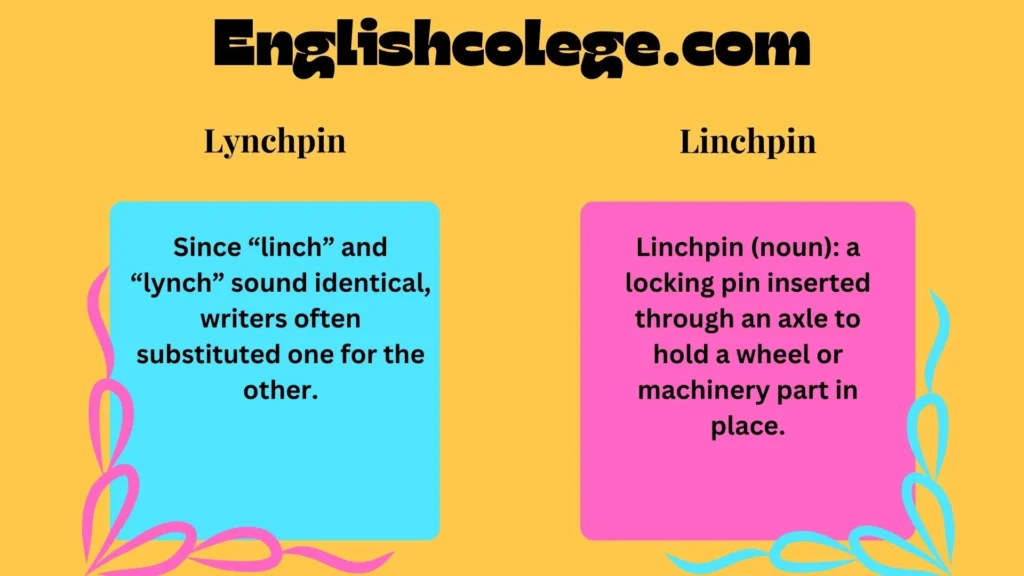
- Phonetic spelling: Since “linch” and “lynch” sound identical, writers often substituted one for the other.
- Historical variants: Before standard spelling (pre-18th century), words were often written however they sounded.
- British influence: Some UK publications and older British dictionaries list “lynchpin” as an alternative form.
Modern Acceptance
“Lynchpin” is still recognized but generally considered secondary.
Think of it like “color” vs. “colour”—same meaning, different acceptance levels.
Usage Trends: What the Data Shows 📊
To understand which form dominates today, let’s look at historical data from linguistic sources such as the Google Ngram Viewer and Oxford Corpus of English.
| Region | Preferred Form | Notes |
|---|---|---|
| United States | Linchpin | Over 95% of usage; primary dictionary form |
| United Kingdom | Lynchpin (minor), Linchpin (dominant) | “Lynchpin” appears occasionally in traditional press |
| Canada | Linchpin | Same trend as U.S. |
| Australia | Linchpin | Rare “lynchpin” in older literature |
| India | Linchpin | American English influence dominant |
Trend summary:
- From 1900 to 1950, both forms appeared interchangeably.
- After 1960, “linchpin” overtook “lynchpin” in virtually all written English.
- Today, editors, teachers, and style guides universally recommend “linchpin.”
Graphical Note
If you checked a Google Ngram graph, you’d see “linchpin” towering over “lynchpin” post-1970—a clear indicator of modern dominance.
Choosing the Right Word: Linchpin or Lynchpin? 🧭
When writing, always ask: What’s the context and audience?
Here’s a simple table to help you decide which spelling fits:
| Context | Correct Form | Explanation |
|---|---|---|
| Academic papers | Linchpin | Standardized English spelling |
| Journalism (US) | Linchpin | Professional and preferred |
| British media | Lynchpin (rare) | Acceptable but less common |
| Corporate documents | Linchpin | Consistent with global standards |
| Informal writing | Either | Style preference |
Rule of Thumb:
When in doubt, go with linchpin—it’s globally accepted and error-proof.
Bonus Tip:
If you’re editing for an international audience, replace “lynchpin” with “linchpin” for clarity and consistency.
Common Confusions and Similar Word Pairs 🔍
Many English words carry dual spellings or regional variations like this one. Recognizing patterns helps prevent mix-ups.
| Word Pair | Region | Preferred Form | Notes |
|---|---|---|---|
| Color / Colour | US / UK | Color (US), Colour (UK) | Regional spelling |
| Sizable / Sizeable | US / UK | Sizable | “Sizeable” appears in British English |
| Ardor / Ardour | US / UK | Ardor | Rooted in Latin “ardere” (to burn) |
| Theater / Theatre | US / UK | Theater (US), Theatre (UK) | Stylistic difference |
| Linchpin / Lynchpin | Global | Linchpin | Variant vs. standard |
Observation: Words ending in “-our” vs “-or” or containing interchangeable vowels often follow US simplification trends. “Linchpin” fits that evolution perfectly.
Real-World Case Studies: Linchpin in Action 🧩
Case Study 1: Business Leadership
At Toyota, the kaizen philosophy identifies every worker as a linchpin in process improvement. The success of their production model depends on each employee being essential—not replaceable.
Case Study 2: Technology
In Apple’s early years, Steve Jobs was the company’s linchpin. His vision and leadership held the creative and technical teams together, proving how one person can be the “pin” of innovation.
Case Study 3: History
During World War II, radar technology became the linchpin of Allied defense strategies. Without it, air defense coordination would’ve collapsed.
These examples show the word’s power beyond mechanics—a single essential part holding the entire system together.

5 Frequently Asked Questions (FAQs) 🤔
What does “linchpin” literally mean?
A linchpin is a metal pin used to secure a wheel or mechanical part, preventing it from sliding off its axle.
Is “lynchpin” incorrect?
Not exactly—it’s a recognized variant spelling, but “linchpin” is the preferred form in modern English.
Do both words mean the same thing?
Yes, both mean “a vital element or person.” The only difference lies in spelling and usage frequency.
Which form should I use in professional writing?
Always use “linchpin.” It’s accepted by dictionaries, publishers, and academic style guides.
Why is “linchpin” more common today?
Because language standardization (especially post-1900) favored simpler, phonetically direct spellings. “Linchpin” became the norm globally.
Conclusion
Whether you spell it “lynchpin” or “linchpin,” the meaning remains constant—something essential, irreplaceable, and stabilizing.
Still, “linchpin” is the correct, modern, and universally accepted form. It’s the version you’ll find in dictionaries, style guides, and professional publications worldwide.
So, next time you describe someone as the linchpin of your team, know you’re not just using a metaphor—you’re echoing a word that’s held things together for centuries, both mechanically and linguistically.
