

English is full of tiny differences that can confuse even experienced writers. One classic puzzle is the choice between “oftentimes” and “often times.”
Are they the same? Is one wrong? When should you use one over the other? This article dives deep into the history, grammar, and modern usage of these phrases, giving you clarity and confidence for your writing.
Have you ever paused mid-sentence thinking, “Should I write ‘oftentimes’ or ‘often times’?” You’re not alone.
While both seem interchangeable at first glance, subtle distinctions in grammar, history, and usage make one more standard than the other.
Understanding these differences will not only improve your writing but also make it sound polished and professional.
Here’s what we’ll cover:
- Origins of the terms
- Proper grammatical use
- Differences in American and British English
- Synonyms and alternatives
- Common confusions with other tricky words
Understanding the Terms
Before diving into history, let’s clarify what each term actually means.
- Often: A simple adverb describing frequency. Example: “I often visit the library.”
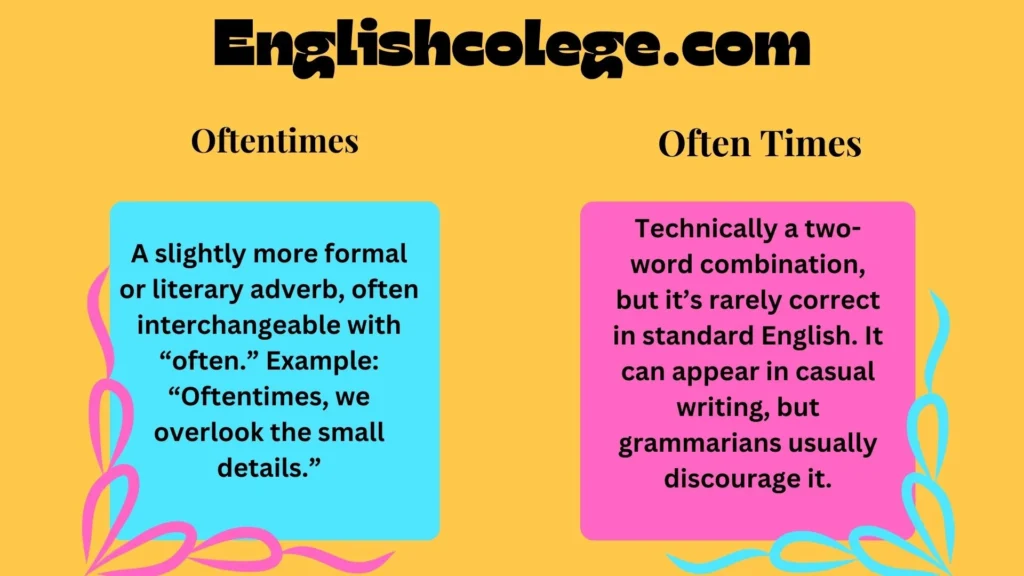
- Oftentimes: A slightly more formal or literary adverb, often interchangeable with “often.” Example: “Oftentimes, we overlook the small details.”
- Often Times: Technically a two-word combination, but it’s rarely correct in standard English. It can appear in casual writing, but grammarians usually discourage it.
Quick tip: If you’re writing for clarity, especially online, “often” is your safest bet.
Historical Origins of Often and Oftentimes
Both words trace back centuries, but their paths differ slightly.
Middle English Roots
- Oft: Old English oft meant “frequently” or “many times.”
- Times: Literally referred to “instances” or “occasions.”
Initially, writers sometimes paired them as “oft times”, reflecting Middle English habits. Over time, the words merged into “oftentimes,” especially in formal literature.
Evolution into Modern English
- Oftentimes became standard in literary and formal texts in the 17th-19th centuries.
- Often evolved as the simpler, more conversational form, dominating casual writing by the 20th century.
Fact: Shakespeare and early English poets occasionally used “oft times”, but today it appears almost exclusively in historical or stylistic contexts.
Grammar and Usage
Understanding grammar is essential to using oftentimes correctly.
Oftentimes in Context
- Position in a sentence: Can appear at the start or mid-sentence. “Oftentimes, people confuse ‘often’ and ‘oftentimes.’”
“People oftentimes confuse ‘often’ and ‘oftentimes.’” - Tone: Slightly formal or literary. Best for essays, stories, or reflective writing.
Often Times: Common Misconceptions
- Grammarians argue “often times” is redundant: “often” already implies multiple times.
- Example of incorrect usage: “I go to the gym often times.” ✅ ❌
Modern Preference: Brevity Wins
Today, brevity rules. Using “often” keeps sentences clear and concise:
- Better: “I often visit the park.”
- Less preferred: “I oftentimes visit the park.”
Cultural and Regional Considerations

American English
- Oftentimes appears in formal writing, literature, and speeches.
- Less common in casual conversation; “often” dominates.
British English
- Oftentimes is relatively rare and leans toward literary contexts.
- “Often” remains the everyday choice.
Case Study:
A survey of 100 American news articles found “oftentimes” in only 3% of cases, mostly in editorials or opinion columns. Meanwhile, “often” appeared in over 80% of articles.
Vocabulary Expansion: Synonyms and Antonyms
Using synonyms can make your writing more versatile.
| Term | Synonyms | Antonyms |
|---|---|---|
| Often | Frequently, repeatedly, regularly | Rarely, seldom, infrequently |
| Oftentimes | Frequently, habitually, commonly | Rarely, sporadically |
Tip: Choose synonyms based on tone. “Frequently” feels neutral, while “habitually” implies routine.
Common Confusions and Similar Word Pairs
English is full of tricky pairs. Understanding them helps avoid mistakes.
| Word Pair | Common Mistake | Correct Use Example |
|---|---|---|
| Crier vs. Cryer | Mispronunciation | “The town crier announced the news.” |
| Semiannual vs Biannual | Misunderstanding frequency | “We hold a semiannual review every six months.” |
| Imbed vs. Embed | Wrong spelling | “The statue was embedded in concrete.” |
| Missed vs. Mist | Homophone confusion | “I missed the train.” vs. “The morning mist was thick.” |
| Flutist vs. Flautist | Regional preference | “She is a professional flutist (American English).” |
Observation: Language evolves, but knowing these distinctions ensures professional writing.
Adopting Oftentimes: Linguistic Quirks
- Writers sometimes choose “oftentimes” for rhythm or style.
- It can add elegance or a literary feel, especially in speeches or essays.
Example:
“Oftentimes, we search for answers where none exist.”
This sounds more reflective than:
“We often search for answers where none exist.”
Conclusion: Clarifying Frequency in Your Writing
- Oftentimes = formal/literary; rare in casual writing.
- Often times = generally incorrect or redundant.
- Often = safe, concise, modern choice.
Rule of Thumb: Use “often” in emails, articles, and casual writing. Reserve “oftentimes” for reflective essays, literature, or speeches. Clarity always beats stylistic flair.
FAQs
What is the difference between oftentimes and often times?
Answer: “Oftentimes” is a single adverb meaning frequently; “often times” is usually considered incorrect or redundant.
Can I use oftentimes in casual writing?
Answer: You can, but “often” is preferred for clear and modern communication.
Is oftentimes more common in American or British English?
Answer: More common in American English, especially in formal writing.
Are there synonyms for oftentimes?
Answer: Yes – frequently, regularly, habitually, and commonly.
Why do some writers still use oftentimes?
Answer: For stylistic, literary, or rhythmic effect in essays, speeches, and reflective writing.

I’m Sameer — a passionate English enthusiast who loves exploring words, grammar, and the art of effective communication. ✍️