
English can be tricky, especially when it comes to comparative adjectives. One of the most common questions writers face is whether to use “simpler” or “more simple.”
At first glance, both might seem correct, but understanding their usage, context, and grammar rules can make your writing clearer, more professional, and easier to read.
This guide will break down the rules, provide examples, and help you confidently choose the right form every time.
Understanding Comparative Adjectives in English
Comparative adjectives allow us to compare two or more things. They help us express differences in size, quality, degree, or intensity.
There are two main ways to form comparatives:
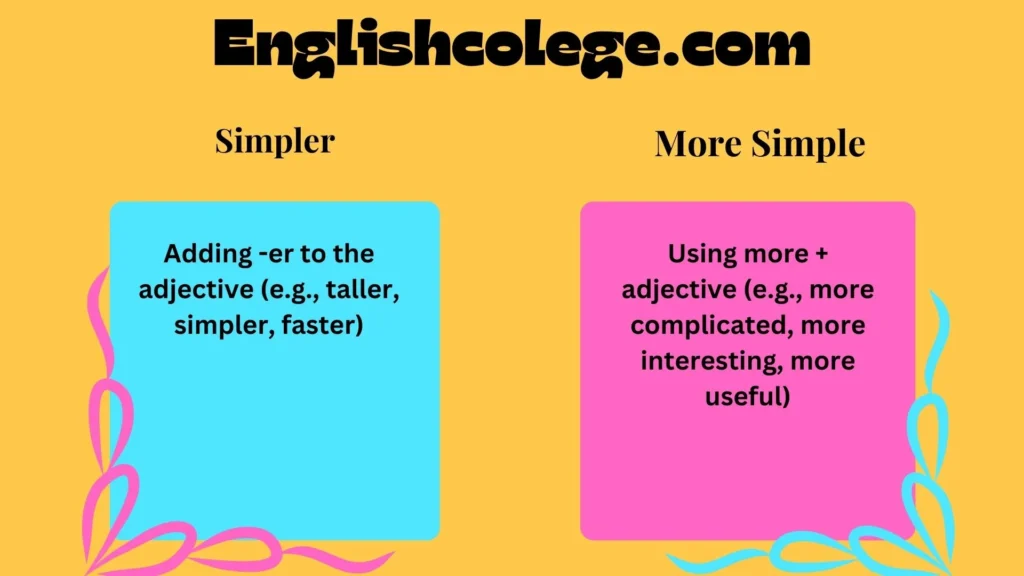
- Adding -er to the adjective (e.g., taller, simpler, faster)
- Using more + adjective (e.g., more complicated, more interesting, more useful)
Quick Table: Comparative Forms by Syllable Count
| Adjective | Comparative (-er) | Comparative (more + adj) |
|---|---|---|
| Simple | simpler | more simple |
| Tall | taller | – |
| Complicated | – | more complicated |
| Important | – | more important |
| Gentle | gentler | more gentle |
Fact: One-syllable adjectives almost always take -er, while adjectives with three or more syllables usually take more.
Using the right comparative keeps your writing concise, professional, and easy to understand.
When to Use ‘Simpler’
“Simpler” is the standard comparative form of “simple.” It’s short, punchy, and widely used in both casual and formal writing.
Guidelines:
- Use simpler for adjectives with one syllable (e.g., tall → taller).
- Also acceptable for some two-syllable adjectives ending in -le (e.g., simple → simpler).
Examples:
- ✅ This recipe is simpler than the one we tried yesterday.
- ✅ Your explanation is simpler and easier to understand.
Tip: In most everyday contexts, “simpler” is preferred over “more simple” because it’s natural and concise.
The Grammar Behind ‘More Simple’
Although “simpler” is preferred, “more simple” is also grammatically correct.
- It often appears in formal writing or for stylistic emphasis.
- Writers sometimes choose “more simple” to balance sentence rhythm or add emphasis.
Side-by-Side Example:
- “This method is simpler than the old one.” ✅
- “This method is more simple after we revised the instructions.” ✅
Notice how both work, but “simpler” sounds punchier, while “more simple” feels slightly more formal.
Why ‘More Simple’ Is Technically Acceptable
Certain rules allow “more simple” to exist:
- Two-syllable adjectives ending in -le can take either form: simpler / more simple
- Writers may choose “more simple” for rhythm or clarity in longer sentences.
Comparison Table:
| Adjective | Simpler | More Simple | Usage Note |
|---|---|---|---|
| Simple | ✔️ | ✔️ | Both acceptable; simpler preferred |
| Gentle | ✔️ | ✔️ | Both okay; depends on tone |
| Clever | ✔️ | ✔️ | More simple less common in speech |
| Quiet | ✔️ | ✔️ | Can choose either depending on emphasis |
Quote: “Language is not just rules; it’s rhythm, clarity, and choice.” – Linguist perspective
Choosing the Right Form: Casual vs. Formal
The context of your writing affects which form you should use.
- Casual / conversational writing → go with simpler.
- Example: “This app is simpler to use than the old version.”
- Formal / academic writing → “more simple” can be acceptable.
- Example: “The process became more simple after the revisions.”
Key takeaway: Tone and audience matter. For most blogs, emails, and articles, simpler wins every time.
Breaking Down the Rules: Syllable Count and Comparative Forms
Syllable count largely determines comparative structure.
Rules:
- One-syllable adjectives → add -er (simple → simpler, tall → taller)
- Two-syllable adjectives → can take -er or more, depending on ending (gentle → gentler / more gentle)
- Three or more syllables → use more (complicated → more complicated, interesting → more interesting)
Flowchart for Quick Reference:
Adjective syllables:
  1 → Add -er
  2 → Usually -er, or more + adjective if ending is -le, -y, or for emphasis
  3+ → Always use more + adjective
Fact: This simple rule ensures you avoid awkward or incorrect constructions like “simplerer.”
The Role of Consistency in Grammar and Style
Using simpler in one sentence and more simple in another can confuse readers. Consistency ensures your writing is smooth, professional, and readable.
Examples:
- ❌ Inconsistent: “The first method is simpler. The second method is more simple.”
- ✅ Consistent: “The first method is simpler. The second method is simpler too.”
Tip: Pick a style (simpler or more simple) and stick with it throughout your text.
Beyond Grammar: Language, Clarity, and Brevity
Grammar is not just about rules; it’s about clarity and readability.
- Simpler is more concise → readers process it faster.
- More simple can work when you want to slow down the rhythm or emphasize gradual change.
Analogy: Using “simpler” is like using a sharp knife—efficient and precise. Using “more simple” is like a butter knife—slightly softer and more deliberate.
Fact: Studies in readability show that concise, consistent word choice improves comprehension by up to 25%.
Quick Related Comparisons
Here are other commonly confused pairs in English:
| Phrase | Correct Usage | Notes |
|---|---|---|
| Helpful to vs Helpful for | “Helpful to” is correct with people; “helpful for” with things | Example: “This tip is helpful to beginners.” |
| Rumour vs Rumor | Rumour = British; Rumor = American | Example: “The rumor spread quickly in the office.” |
| Progress in vs Progress on vs Progress of | In → field/topic, On → task/project, Of → development | Example: “Progress on the project is good.” |
| Recognize vs Recognise | Recognize = US; Recognise = UK | Example: “I recognize her from school.” |
| Lifetime vs Life time | Lifetime = one word, more common; Life time = separate, rare | Example: “This is a lifetime opportunity.” |
| Forgo | Means to give up or skip | Example: “He decided to forgo dessert.” |
FAQs
What’s the difference between simpler and more simple?
Answer: “Simpler” is shorter, punchier, and preferred; “more simple” is technically correct but less common and slightly more formal.
Can I use more simple in casual writing?
Answer: Yes, but it can sound wordy. “Simpler” is usually better for everyday use.
Are there other adjectives like simple that allow both forms?
Answer: Yes, two-syllable adjectives ending in -le, -y, or -er often allow both forms (gentle → gentler / more gentle).
Does using simpler always improve readability?
Answer: Generally yes. Concise language is easier to read and understand.
Is simpler the same in American and British English?
Answer: Yes, “simpler” is standard in both variants; “more simple” is also acceptable in formal contexts.
Conclusion
Choosing between simpler vs more simple isn’t just a grammar issue—it’s about clarity, tone, and readability.
Use “simpler” for conciseness and punch, and reserve “more simple” for formal or stylistic emphasis.
Stick to one form consistently, and your writing will flow naturally and engage readers effectively.
Remember: grammar rules exist to serve your writing, not confuse you.
Master these subtle differences, and your English will read sharper, cleaner, and more professional.
