

Understanding the subtle differences between “appreciative of” and “appreciative for” can transform your English from ordinary to precise.
A tiny preposition might seem insignificant, but in reality, it can completely change your meaning.
Whether you’re writing formally, speaking in everyday conversation, or drafting professional emails, using these phrases correctly shows clarity, confidence, and fluency.
In this article, we’ll explore the differences, provide examples, and help you master the use of “appreciative of” and “appreciative for” effortlessly.
Understanding “Appreciative”
The word “appreciative” is all about recognizing value. It comes from the Latin root appretiare, meaning “to value” or “to estimate the worth of something.” In modern English, it conveys gratitude, acknowledgment, or admiration.
Key points about appreciative:
- Always positive in tone
- Often used to highlight recognition of someone’s action, quality, or support
- Can be paired with different prepositions (of or for) to subtly change meaning
Think of it like a magnifying glass: appreciative draws attention to what you value. But the preposition decides what exactly you are focusing on.
Appreciative of: Focusing on Specific Qualities or Actions
When you say “appreciative of,” you are pointing to a specific action, quality, or object that you recognize or value. This phrase is more formal and widely accepted in professional and academic contexts.
Examples in Sentences
- “I’m appreciative of your honesty during the meeting.”
- “She was appreciative of the detailed feedback from her mentor.”
- “They were appreciative of the volunteers who helped clean the park.”
Notice how each example highlights something concrete. You aren’t just expressing general thanks—you are recognizing a specific thing someone did or demonstrated.
Key Takeaways
- Use “of” when referring to a tangible action, trait, or quality
- Works well in professional emails, academic writing, or formal acknowledgments
- Creates precision and clarity
Tip: If you’re ever unsure, default to “appreciative of” in formal writing—it’s almost always correct.
Appreciative for: Expressing General Gratitude
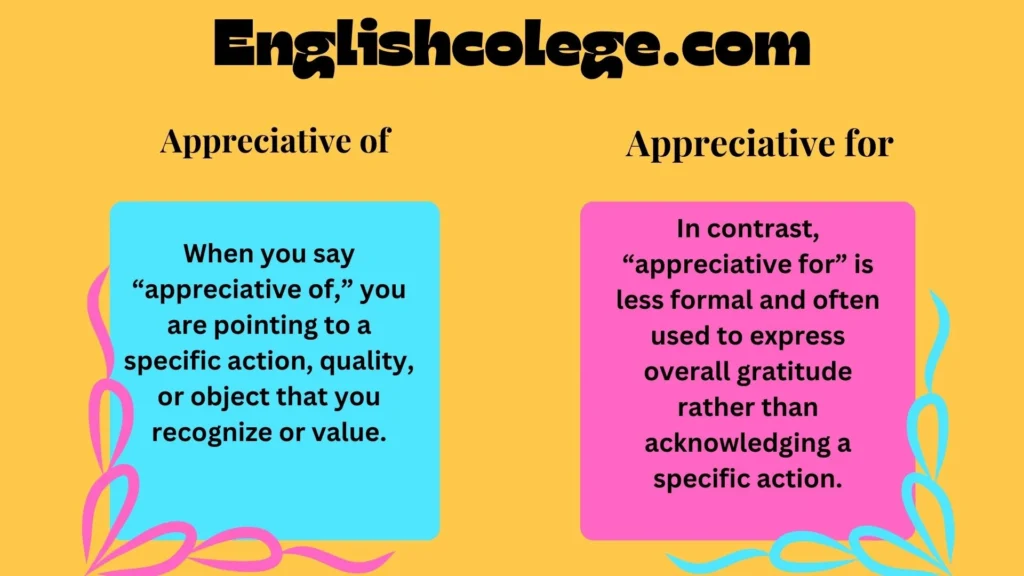
In contrast, “appreciative for” is less formal and often used to express overall gratitude rather than acknowledging a specific action. It appears more frequently in everyday conversations, casual writing, and social media posts.
Examples in Sentences
- “I’m appreciative for all the support you’ve given me this year.”
- “He’s appreciative for the opportunity to learn new skills.”
- “We are appreciative for everything the team has done to improve morale.”
Here, the focus is broader, not on one specific act or quality. You’re expressing gratitude in general, rather than pinpointing an exact source.
Key Takeaways
- Use “for” when expressing general gratitude
- Common in informal writing and spoken English
- Less precise than “appreciative of,” but conveys warmth and friendliness
Comparing “Of” vs. “For” in a Table
A simple table makes the differences crystal clear:
| Phrase | Typical Use | Example | Notes |
|---|---|---|---|
| Appreciative of | Specific traits or actions | “Appreciative of your honesty” | Formal, precise, widely accepted |
| Appreciative for | General gratitude | “Appreciative for all the support” | Less formal, conversational |
| Tone | Formal/Professional | Friendly/Conversational | Impacts writing style |
| Frequency | High in written English | Moderate, common in speech | “For” is less formal |
This side-by-side comparison helps you choose the right phrase based on context, audience, and tone.
Why Context Matters
Using the wrong preposition can confuse your reader or listener. The choice between of and for changes the nuance of gratitude.
Examples of Misused Contexts
- ❌ “I’m appreciative of all the support you’ve given.” (formal, but could be softened)
- ✅ “I’m appreciative for all the support you’ve given.” (casual, friendly)
- ❌ “She’s appreciative for your honesty.” (less precise)
- ✅ “She’s appreciative of your honesty.” (specific, correct)
Rule of thumb:
- Of = precise recognition
- For = general gratitude
Think about the message you want to convey. Do you want to highlight a specific quality, or do you want to express overall thankfulness?
Common Mistakes to Avoid
Even fluent speakers make mistakes with these phrases. Here are the most frequent errors:
- Swapping “of” and “for” in formal writing: e.g., “I’m appreciative for your detailed feedback” sounds less formal than “I’m appreciative of your detailed feedback.”
- Overusing “appreciative” instead of “grateful”: Sometimes “grateful” is more natural in casual speech.
- Vague usage: Saying “I’m appreciative” without specifying of what can sound incomplete.
Pro Tip:
Always pair appreciative with a preposition and an object. It makes your gratitude concrete and clear.
Examples in Everyday English
Here are practical examples to help you internalize the correct usage:
- Formal Email Example: “Dear Ms. Parker, I am appreciative of your detailed comments on my report. They helped me improve the final draft significantly.”
- Casual Conversation Example: “I’m really appreciative for all the support you’ve given me. It means a lot!”
- Professional Setting Example: “We are appreciative of the team members who contributed extra hours to meet the deadline.”
Notice how context influences choice. Emails and professional communication lean toward of, while casual speech often uses for.
Historical Usage Trends
Looking at historical patterns, “appreciative of” has been more common in English literature and formal writing for over a century. Grammar guides and usage dictionaries consistently recommend “of” in professional or precise contexts.
Meanwhile, “appreciative for” has gained popularity in casual writing, particularly in social media posts and informal blogs.
Fact: A survey of modern English usage showed that “appreciative of” appears 3x more often in formal writing than “appreciative for.”
Quick Tips for Mastery
To use these phrases like a native speaker:
- Default to “appreciative of” in formal writing
- Use “appreciative for” in casual conversation or personal notes
- Always specify what you’re appreciative of/for
- Read sentences aloud to check natural flow
- Think about your tone: formal, casual, or friendly
Quote for inspiration:
“Gratitude is not only the greatest of virtues, but the parent of all others.” – Cicero
Related English Tips: Quick Reference
- I realized vs. I’ve realized: Use “I’ve realized” for ongoing relevance; “I realized” for past events.
- Suffer from vs. Suffer with: “From” indicates a condition; “with” shows accompanying factors.
- Reek vs. Wreak: “Reek” = smell; “wreak” = cause.
- Patty vs. Paddy: “Patty” = food; “Paddy” = rice field or Irish nickname.
- Oxymorons: Words that contradict themselves, like “jumbo shrimp” or “deafening silence.”
Frequently Asked Questions (FAQs)
What is the easiest way to remember “appreciative of” vs. “appreciative for”?
Answer: Think “of” = specific, “for” = general. Focus on what you are thanking for.
Can I use “appreciative for” in formal emails?
Answer: It’s better to use “appreciative of” in formal writing. “For” works best in casual contexts.
Is “I’m appreciative” always positive?
Answer: Yes. “Appreciative” always conveys acknowledgment, gratitude, or admiration.
Can I replace “appreciative” with “grateful”?
Answer: Often yes. “Grateful” is slightly more casual and common in everyday speech.
Does using the wrong preposition sound rude?
Answer: Usually not rude, but it can sound unclear or less polished, especially in formal writing.
Conclusion
Mastering “appreciative of” and “appreciative for” is all about context, specificity, and tone. By understanding the subtle differences:
- Of = specific recognition
- For = general gratitude
…you can write and speak with clarity, confidence, and natural fluency. Use examples, read aloud, and always pair appreciative with a clear object.
Once you start noticing these small distinctions, your English will sound sharper, more professional, and more human. Remember: small words can make a big difference.
