

English can be tricky, especially when it comes to verbs like “feel” and “felt”. Even native speakers sometimes struggle to use them correctly.
Add in homophones and commonly confused words, and you’ve got a recipe for misunderstandings.
In this guide, we’ll explore everything from present and past tense usage, grammar rules, idioms, pronunciation tips, and homophones, to writing tips for emails and formal English.
By the end, you’ll confidently know how and when to use “feel,” “felt,” and other tricky words in your writing and speech.
Understanding ‘Feel’ and ‘Felt’
The Verb ‘Feel’ – Present Tense
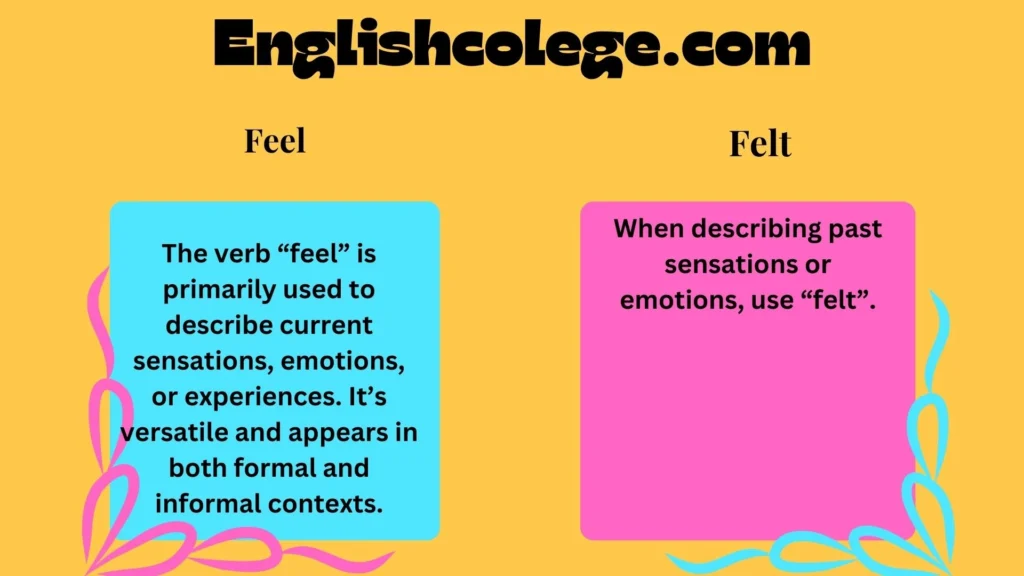
The verb “feel” is primarily used to describe current sensations, emotions, or experiences. It’s versatile and appears in both formal and informal contexts.
Examples:
- I feel tired after the long day.
- She feels nervous before presentations.
- Do you feel the cold wind outside?
Idiomatic expressions with “feel”:
- Feel like – to want or desire (I feel like having ice cream.)
- Feel for – to empathize (I really feel for her situation.)
- Feel up to – to be capable or ready (I don’t feel up to running today.)
Tips:
- Use “feel” when discussing present experiences.
- Combine with adjectives or emotions for clarity (I feel happy, anxious, or cold).
The Past Tense ‘Felt’
When describing past sensations or emotions, use “felt”.
Examples:
- Yesterday, I felt exhausted after the workout.
- He felt proud of his achievement.
- We felt the tremor of the earthquake.
Important points:
- “Felt” is the simple past of “feel.”
- It can also be used in past participle structures (I have felt this way before).
- Always check for tense consistency in sentences: mix present “feel” with past “felt” only when the context allows.
Case Study:
Imagine two sentences:
- I feel nervous about the test tomorrow.
- I felt nervous about the test yesterday.
Sentence 1 talks about the present, and sentence 2 clearly situates the emotion in the past.
Grammar Deep Dive: Syntax and Sentiment
Syntax patterns:
| Pattern | Example | Notes |
|---|---|---|
| Subject + feel + adjective | I feel happy | Present emotion |
| Subject + feel + noun | She feels excitement | Present sensation |
| Subject + felt + adjective | He felt tired | Past emotion |
| Subject + have/has + felt + adjective | They have felt nervous | Past participle |
Mood and modality:
- “Feel” and “felt” can indicate certainty or possibility.
- I feel that this will work. → Present opinion
- I felt that it might not work. → Past opinion
Tips:
- Avoid overcomplicating. Stick to feel + adjective/noun for clarity.
- Always match tense with time reference.
Pronunciation and Common Confusions
Many confuse feel and felt in speech due to similar sounds.
Pronunciation tips:
- Feel: /fiːl/ → long “ee” sound
- Felt: /fɛlt/ → short “e,” ends with “lt”
Common mistakes:
- Saying I feeled instead of I felt
- Using “felt” for present experiences
Quick memory tip:
If it’s now, use “feel.” If it’s then, use “felt.”
Homophones and Commonly Confused Words
English is full of words that sound the same but mean different things. Here’s a quick guide:
Piece vs. Peace
- Piece – a part of something (Can I have a piece of cake?)
- Peace – calm or absence of conflict (World peace is a dream.)
Aureole vs. Oriole
- Aureole – a radiant light or halo (The saint was surrounded by an aureole.)
- Oriole – a type of bird (The Baltimore Oriole sings beautifully.)
Incase vs. In Case
- In case – if something happens (Take an umbrella in case it rains.)
- Incase – incorrect spelling; avoid
From My End vs. From My Side
- From my end – usually tech/business context (Everything looks fine from my end.)
- From my side – personal perspective (From my side, it was a mistake.)

Formal Usage: “In which,” “Of which,” etc.
| Expression | Usage Example | Notes |
|---|---|---|
| In which | The meeting, in which he spoke, lasted two hours. | Adds clarity in formal writing |
| Of which | She owns three cars, two of which are electric. | Refers to a subset |
| At which | The moment at which she arrived was critical. | Refers to time |
| To which | The house to which they moved is old. | Refers to direction or object |
Tip: Use these in formal or academic writing. Avoid overusing in casual emails.
Email and Writing Pitfalls
Best vs. Bests
- Best – correct for greetings or conclusions (Best regards)
- Bests – incorrect; not commonly used
Other tips:
- Keep language concise and clear
- Avoid mixing homophones
- Proofread before sending
Regional Differences in ‘Feel’ and ‘Felt’
While American and British English generally follow the same rules:
- American English tends to use “I feel like” more in casual speech
- British English might favor “I feel as though” in formal contexts
Subtle differences appear in idioms:
- Feel under the weather → widely used in both
- Feel peckish → more common in the UK
Idioms and Expressions
Common idioms with “feel”:
- Feel blue – feel sad
- Feel the pinch – experience financial strain
- Feel out of place – uncomfortable in a situation
Example sentences:
- After the news, she felt blue for days.
- With rising bills, many feel the pinch.
Quick Reference Tables
Feel vs Felt Usage
| Tense | Usage | Example |
|---|---|---|
| Present | Current emotion/sensation | I feel happy. |
| Past | Past emotion/sensation | I felt happy yesterday. |
| Past participle | Present perfect | I have felt happy many times. |
Homophones Cheat Sheet
| Word 1 | Word 2 | Meaning / Usage |
|---|---|---|
| Piece | Peace | Part vs Calm |
| Aureole | Oriole | Halo vs Bird |
| Incase | In case | Incorrect vs Correct |
| From my end | From my side | Tech/business vs Personal perspective |
Two-Minute English Tips
- Always check tense consistency with “feel/felt.”
- When confused, ask: “Is it happening now or did it happen already?”
- Keep a small homophone cheat sheet handy for emails and writing.
- Practice idioms with ‘feel’ to sound more natural.
Frequently Asked Questions (FAQs)
What is the difference between feel and felt?
Feel is present tense, while felt is the past tense of the verb.
Can I use felt for future situations?
No, felt is strictly past. Use feel or will feel for future references.
Is “I have felt tired today” correct?
Yes, it’s the present perfect tense, showing past experience affecting now.
Are “piece” and “peace” interchangeable?
No, piece refers to a part, peace refers to calm or harmony.
Should I write “from my end” or “from my side”?
Use from my end for professional/technical contexts, from my side for personal opinions.
Conclusion
Mastering feel and felt takes practice, but understanding the difference in tense, usage, and context makes a huge difference.
Pair that with knowledge of homophones, idioms, and formal English phrases, and your writing and speech will become clearer, more professional, and natural.
Remember: short, clear sentences combined with practical examples are the key. Practice using tables, idioms, and real-life situations to make your English more confident.
