
Understanding the difference between “become” and “became” is crucial for anyone who wants to write or speak English confidently.
These two words are forms of the same verb but belong to different tenses and contexts.
Using them incorrectly can confuse readers or listeners, even in casual conversation.
In this article, you’ll learn everything about “become” and “became”, including their meanings, practical usage, common mistakes, and tips to master them effortlessly.
Understanding the Basics: Present and Past Tense
English verbs change depending on time, and understanding tense is the first step in mastering become vs became.
- Present tense shows actions happening now or regularly.
- Past tense shows actions that already happened.
Examples:
- Present: I become more confident every day.
- Past: She became a skilled pianist last year.
Notice how the verb form changes to indicate time and completion.
Quick Fact: Most English verbs follow this pattern, but “become” is irregular. Its past form is “became”, not “becomed.”
Defining “Become” and “Became”
Let’s break down the meanings:
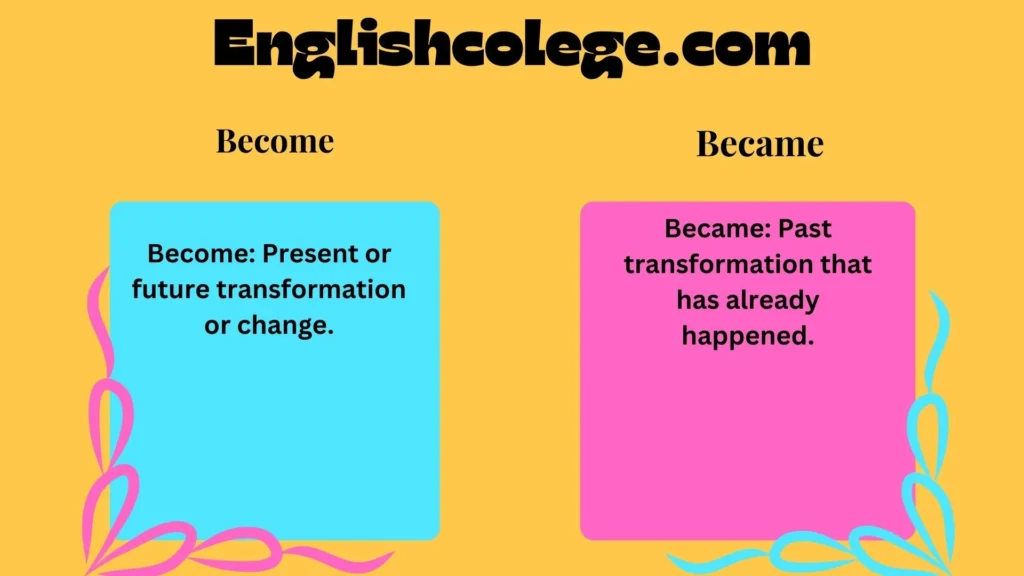
- Become: Present or future transformation or change.
- Became: Past transformation that has already happened.
| Verb Form | Tense | Example Sentence |
|---|---|---|
| Become | Present/Future | I want to become a doctor. |
| Became | Past | She became a doctor last year. |
Key takeaway: “Become” looks forward or describes an ongoing process, while “became” looks back at completed changes.
What It Means to “Become” Something
“Become” often describes a transformation, not just physical changes. It can be used for personality, career, habits, or even abstract qualities.
Examples of transformations:
- Literal: He wants to become a pilot.
- Figurative: She hopes to become more patient.
“Change is the only constant; to grow is to become.” – Anonymous
Here, becoming doesn’t just mean changing; it implies growth, evolution, or progression.
The Transformation Indicated by “Became”
“Became” refers to changes that already occurred. It signals completion.
Examples:
- Literal: He became the CEO after years of hard work.
- Figurative: Over time, she became more confident in public speaking.
Notice the subtlety: “became” emphasizes the result, not the process.
Quick Tip: If the change is ongoing or expected, use become. If it is finished, use became.
Practical Usage of “Become” in Sentences
Here’s how you can use “become” in daily English:
- Positive statements:
- I become happy when I listen to music.
- Negative statements:
- He doesn’t become angry easily.
- Questions:
- Did she become interested in the topic?
Mini Table for Practice:
| Sentence Type | Example |
|---|---|
| Affirmative | I become stronger each day. |
| Negative | He doesn’t become impatient. |
| Question | Do you become tired quickly? |
How “Became” Fits into Past Narratives
When telling a story or describing past events, “became” is invaluable. It naturally fits into narratives and timelines.
Example Paragraph:
When she was a teenager, Maria loved drawing. Over time, she became skilled at digital art. By her twenties, she became a professional illustrator, working with major clients worldwide.
Here, “became” moves the story forward, marking milestones and completed changes.
Distinguishing “Become” from “Becomes”
Many learners confuse become and becomes. The difference is subtle but important:
- Become – base form, used with I, you, we, they
- Becomes – third-person singular, used with he, she, it
| Subject | Correct Usage |
|---|---|
| I | I become happy. |
| She | She becomes happy. |
| They | They become happy. |
Tip: When in doubt, ask yourself: “Is the subject singular third person?” If yes, use becomes.
Exploring Present Perfect Tense: “Has Become” and “Have Become”

The present perfect tense connects the past and the present. It shows that a change started before now but still matters.
Examples:
- She has become an expert in coding over the past five years.
- They have become close friends since meeting at school.
Rule: Use has with singular subjects, have with plural subjects.
| Form | Usage | Example |
|---|---|---|
| Has become | Singular, present perfect | He has become more patient. |
| Have become | Plural, present perfect | We have become stronger as a team. |
Why “Has Became” Is Grammatically Incorrect
A common mistake is using “has became” instead of “has become.”
Wrong: She has became famous.
Correct: She has become famous.
Explanation:
- “Became” = simple past → doesn’t combine with has/have.
- “Become” = past participle → pairs with has/have to form present perfect.
Rule of Thumb:
Has/Have + past participle = present perfect
The Subtleties of “Would Become”
“Would become” is used for conditional or habitual situations in the past or future.
Examples:
- Conditional: If he trained harder, he would become the fastest runner.
- Habitual past: He would become nervous whenever he spoke in public.
Tip: “Would become” often implies frequency, expectation, or hypothetical change.
Common Mistakes and Confusions
Even experienced speakers slip up. Here are common pitfalls:
- Become vs Becomes vs Became
- Has become vs Had become
- After long time → Correct: after a long time
- Payed or Paid? → Always paid
- Contiguous vs Continuous → Contiguous = touching, Continuous = unbroken
Table: Common Errors
| Mistake | Correct Form | Example |
|---|---|---|
| Has became | Has become | She has become an expert. |
| After long time | After a long time | He returned after a long time. |
| Payed | Paid | I paid the bill yesterday. |
| Contiguous | Contiguous | The rooms are contiguous. |
| Continuous | Continuous | She ran for a continuous hour. |
Quick Tips & Tricks
Here’s a cheat sheet for all forms of “become”:
| Form | Tense/Usage | Example |
|---|---|---|
| Become | Present/Future | I become tired after studying. |
| Becomes | Present 3rd person singular | She becomes tired easily. |
| Became | Past | He became tired yesterday. |
| Has Become | Present perfect | He has become stronger this year. |
| Have Become | Present perfect plural | They have become friends. |
| Would Become | Conditional/Habitual past/future | He would become nervous in crowds. |
Pro Tip: Memorize this table; it’s your shortcut to error-free usage.
Frequently Asked Questions
What is the difference between “become” and “became”?
Answer: “Become” is present/future tense, while “became” is past tense.
Can I say “has became”?
Answer: No. Use “has become” because “became” is past tense, not past participle.
When do I use “would become”?
Answer: Use it for conditional or repeated past situations.
Is “becomes” the same as “become”?
Answer: No. “Becomes” is only used with third-person singular subjects.
Can “become” be used for abstract qualities?
Answer: Yes. It can describe personality, skills, or habits, not just literal changes.
Conclusion
Mastering “become vs became” takes practice, but understanding tense, context, and form makes it simple. Remember:
- Become = present/future, ongoing process
- Became = past, completed change
- Use has/have become for present perfect situations
- Avoid common errors like “has became”
With tables, examples, and these tips, you can now confidently use all forms of become in everyday English.
Practice tip: Write a short paragraph about yourself using each form: become, becomes, became, has/have become, would become. You’ll see how natural it feels!
