
English learners often stumble when it comes to “shown” vs “showed”. These two forms of the verb show are used in different contexts, yet many writers and speakers confuse them.
In this article, we’ll break down the differences, provide clear examples, and give practical tips to help you use “shown” and “showed” correctly every time.
Whether you’re writing an essay, sending an email, or speaking in public, understanding these distinctions can make your English more fluent, professional, and precise.
The Basics of “Show”: Understanding the Irregular Verb
The verb show is an irregular verb, which means it doesn’t follow the standard pattern of adding -ed for the past tense. Its forms vary depending on tense and sentence structure.
Here’s a quick reference table for the different forms of show:
| Tense | Form | Example Sentence |
|---|---|---|
| Present | show | I show my work to my teacher. |
| Simple Past | showed | Yesterday, I showed my project to the class. |
| Past Participle | shown | I have shown my best ideas during the meeting. |
Key fact: Many learners mistakenly use “shown” in simple past situations. Remember, “showed” is for completed actions in the past without auxiliary verbs.
Diving Into “Showed”: Past Tense Usage
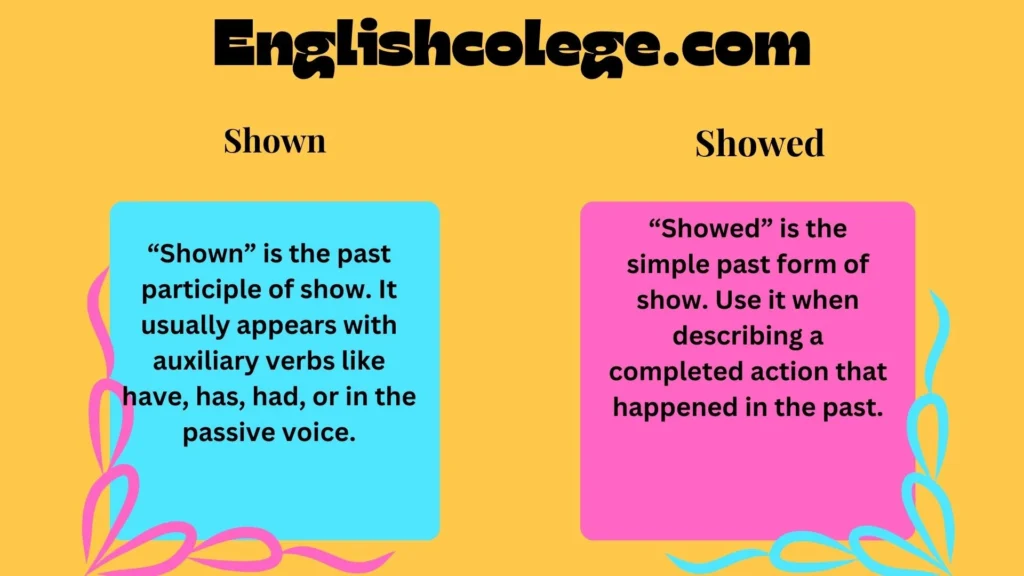
“Showed” is the simple past form of show. Use it when describing a completed action that happened in the past.
Examples:
- “I showed my friend the photos from the trip.”
- “He showed excellent leadership during the project.”
- “We showed the children how to plant seeds.”
Tips for using “showed”:
- Use it without have/has/had.
- Avoid using it in perfect tenses (that’s when “shown” is used).
- Perfect for storytelling: “Last week, she showed me her new artwork.”
Common mistakes:
- ❌ “I have showed you the report.” → Incorrect
- ✅ “I have shown you the report.” → Correct
Breaking Down “Shown”: Past Participle Usage
“Shown” is the past participle of show. It usually appears with auxiliary verbs like have, has, had, or in the passive voice.
When to Use “Shown”
- Perfect tenses:
- Present perfect: “I have shown the results to my boss.”
- Past perfect: “She had shown her work before the deadline.”
- Passive voice:
- “The movie was shown at the festival.”
- “The instructions have been shown to all students.”
- Formal or written English:
- “Evidence has been shown to support the theory.”
Quick tip: If you hear “have/has/had” before the verb, the correct form is almost always shown, not showed.
Comparing “Showed” vs “Shown” in Context
Here’s a side-by-side comparison to clarify the difference:
| Context | Correct Form | Example |
|---|---|---|
| Simple past | Showed | “I showed him my favorite book yesterday.” |
| Present perfect | Shown | “I have shown him my favorite book many times.” |
| Passive voice | Shown | “The book was shown to the entire class.” |
Notice how “showed” is used for finished actions, while “shown” connects with perfect tenses or passive structures.
Active vs. Passive Voice: How It Affects Your Choice
The choice between “showed” and “shown” often depends on whether the sentence is active or passive.
Active voice: The subject performs the action. Use showed for past tense.
- “She showed her artwork to the class.”
- “They showed the results to the manager.”
Passive voice: The subject receives the action. Use shown for past participle.
- “Her artwork was shown to the class.”
- “The results have been shown to the manager.”
Rule of thumb: Active = simple past → showed. Passive = perfect tense → shown.
Common Pitfalls and How to Avoid Them
Even advanced speakers make mistakes with these verbs. Here’s what to watch out for:
1. Using “shown” in simple past
- ❌ “I shown him my drawing yesterday.”
- ✅ “I showed him my drawing yesterday.”
2. Using “showed” in perfect tenses
- ❌ “I have showed the photos.”
- ✅ “I have shown the photos.”
3. Forgetting auxiliary verbs in past participles
- Always pair shown with have, has, had, or been.
Mnemonic: Showed = Past Alone; Shown = Perfect Tone.
Practical Examples in Complex Sentences
Here are some examples of “showed” and “shown” in sentences with multiple clauses or contexts:
- “By the time I arrived, they had already shown the film to the audience.”
- “She showed him how to use the new software while he was learning the job.”
- “The results have been shown to all team members to ensure clarity.”
- “He showed kindness even when no one was watching.”
These examples demonstrate that sentence structure directly affects the correct choice of verb form.
Enhancing Your Grammar Confidence
Here are actionable ways to master shown vs showed:
1. Create mini-tables for practice
| Tense | Correct Form | Example |
|---|---|---|
| Simple past | Showed | “I showed my report yesterday.” |
| Present perfect | Shown | “I have shown my report today.” |
| Past perfect | Shown | “She had shown her results before the meeting.” |
2. Practice active vs passive distinctions
- Write five sentences in active voice using “showed.”
- Convert them to passive voice and use “shown.”
3. Use it in real contexts
- Emails: “I have shown the presentation to the team.”
- Reports: “The results were shown in the latest chart.”
- Stories: “He showed me how to solve the problem.”
4. Read aloud
- Reading sentences out loud helps your brain naturally choose the correct verb form.
5. Use visual cues
- Associate shown with completed and shared information (perfect tenses).
- Associate showed with past actions that are finished and specific.
Case Study: How Misusing “Shown” vs “Showed” Affects Communication
Imagine sending a professional email:
Incorrect: “I have showed you the documents last week.”
- Sounds awkward and unprofessional.
Correct: “I showed you the documents last week.”
Correct (formal/perfect tense): “I have shown you the documents.”
Insight: Using the wrong form can confuse readers, reduce clarity, and make communication appear careless.
Examples of “Shown” in Complex Tenses
- Present perfect: “We have shown remarkable improvement in the last quarter.”
- Past perfect: “Before the meeting, she had shown all the data to her manager.”
- Future perfect: “By next month, we will have shown all participants the new procedures.”
- Passive + perfect: “The new software has been shown to the entire team for testing.”
Tables like this help learners visualize patterns and remember usage.
Enhancing Vocabulary: Synonyms and Contextual Uses
Sometimes, “showed” and “shown” can be replaced by demonstrated, presented, revealed, displayed, depending on context:
| Verb | Example | When to Use |
|---|---|---|
| Demonstrated | “She demonstrated her idea to the class.” | Formal presentations, clear examples |
| Presented | “He presented the report yesterday.” | Formal, past tense |
| Revealed | “The study revealed surprising results.” | Past or present perfect, discovery |
| Displayed | “The museum displayed rare artifacts.” | Passive voice often |
This improves variety and prevents repetition while keeping meaning intact.
FAQs
What is the difference between “showed” and “shown”?
Answer: “Showed” is the simple past tense; “shown” is the past participle used with perfect tenses or passive voice.
Can “shown” be used in simple past sentences?
Answer: No, “shown” requires auxiliary verbs like have, has, had, or is used in passive constructions.
How do I know when to use “showed”?
Answer: Use “showed” for completed past actions without auxiliary verbs.
Is it wrong to say “I have showed it to you”?
Answer: Yes, the correct form is “I have shown it to you.”
Can “showed” be used in passive voice?
Answer: Generally no; passive constructions require the past participle “shown.”
Conclusion
Mastering shown vs showed comes down to understanding tense, auxiliary verbs, and voice. Remember:
- Showed = simple past → completed actions in the past
- Shown = past participle → perfect tenses or passive voice
Using these correctly will improve your writing, speaking, and professional communication.
Practice by writing sentences, reading aloud, and reviewing examples in real-life contexts. Once you get it right, it becomes second nature.
