
Have you ever paused mid-sentence, unsure whether to say “My wife and I” or “My wife and me”? You’re not alone.
Even native English speakers stumble over this one. Understanding the difference isn’t just about sounding polished—it’s about clarity, correctness, and sometimes, even social etiquette.
In this guide, we’ll break down the grammar rules, give practical examples, and show you how to use these phrases confidently in any situation.
By the end, you’ll never second-guess yourself again.
Understanding Subjective vs. Objective Cases
The confusion between “My wife and I” and “My wife and me” comes from English pronoun cases. Pronouns in English fall into two main categories:
- Subjective Case (Nominative) – Used when the pronoun is the doer of the action. Examples: I, he, she, we, they.
- Objective Case – Used when the pronoun is the receiver of the action. Examples: me, him, her, us, them.
Here’s a simple table to clarify:
| Case | Pronoun Alone | With Another Person | Example Sentence |
|---|---|---|---|
| Subjective | I | My wife and I | My wife and I are visiting New York next week. |
| Objective | Me | My wife and me | The photographer took a picture of my wife and me. |
Tip: If you’re ever unsure, remove “my wife and” from the sentence. Does it still make sense?
- ✅ “I am visiting New York” ✅ Correct
- ❌ “Me am visiting New York” ❌ Wrong
This simple trick can save you from embarrassing grammar mistakes.
When to Use “My Wife and I”
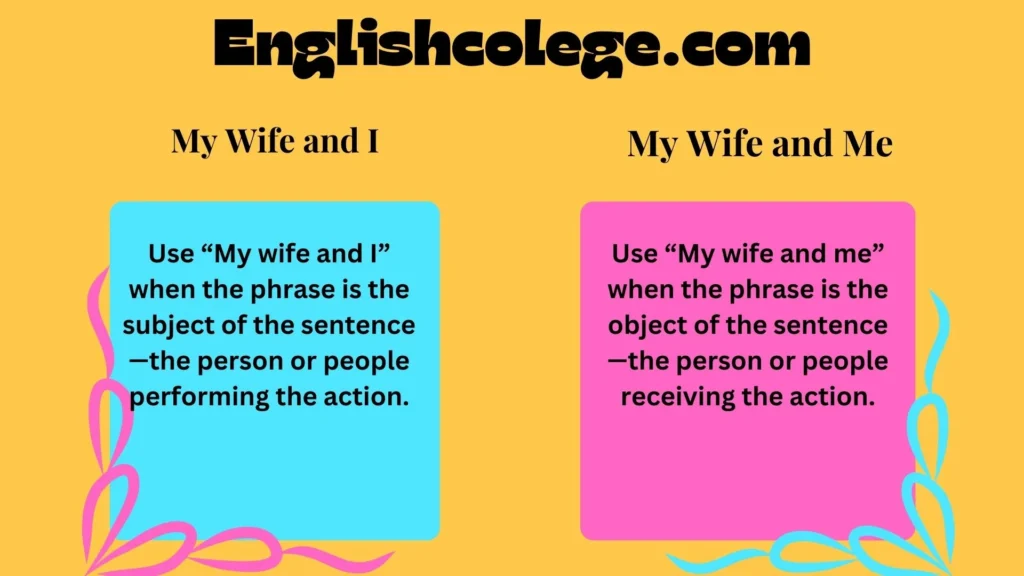
Use “My wife and I” when the phrase is the subject of the sentence—the person or people performing the action.
Examples:
- Correct: My wife and I went to the museum last weekend.
- Incorrect: The gift was for my wife and I.
Notice how “I” is the subject here. It performs the action—went.
Quick Tip: Remove “my wife and” and check:
- “I went to the museum” ✅ Makes sense
- “Me went to the museum” ❌ Wrong
Case Study:
Sarah, a professional writer, always struggled with this. She wrote:
“The award was given to my wife and I.”
After learning the rule, she corrected it to:
“The award was given to my wife and me.”
Her writing instantly sounded more polished and professional.
When to Use “My Wife and Me”
Use “My wife and me” when the phrase is the object of the sentence—the person or people receiving the action.
Examples:
- Correct: The manager congratulated my wife and me on the promotion.
- Incorrect: My wife and me are going to the seminar.
Again, remove “my wife and” to check:
- “The manager congratulated me” ✅ Correct
- “Me are going to the seminar” ❌ Wrong
Quick Test Table:
| Sentence | Subject or Object? | Correct Form |
|---|---|---|
| My wife and I are moving to Seattle. | Subject | I ✅ |
| The gift was for my wife and me. | Object | Me ✅ |
| My wife and me went to the party. | Subject | Wrong ❌ |
| She called my wife and I yesterday. | Object | Wrong ❌ |
This simple technique prevents the most common mistakes.
Politeness and Word Order
English isn’t just about grammar—it’s also about etiquette. People generally place others first when listing people in a sentence.
- ✅ “My wife and I went shopping.” (Polite, standard)
- ❌ “I and my wife went shopping.” (Grammatically correct, but sounds awkward and selfish)
Quote: “Grammar is the logic of speech, etiquette is the manners of it.”
So, when in doubt, mention the other person first. It shows respect and keeps your sentence natural.
Common Mistakes and Misconceptions

Even experienced writers slip up with these phrases. Here are the most frequent mistakes:
- Using “I” in object position: The teacher saw my wife and I in the classroom. ❌
Correct: The teacher saw my wife and me. ✅ - Using “me” in subject position: Me and my wife went hiking. ❌
Correct: My wife and I went hiking. ✅ - Overusing “myself”: My wife and myself are hosting the event. ❌
Correct: My wife and I are hosting the event. ✅
Fact: Many people wrongly assume “myself” sounds fancier. In reality, it’s only correct as a reflexive pronoun:
“I made dinner myself.”
Tips for Remembering the Rule
Here are proven tips to avoid confusion:
- Remove the other person:
- “My wife and I” → “I”
- “My wife and me” → “me”
- Subject vs. object test:
- Subject = doer → use I
- Object = receiver → use me
- Think of reflexive use for “myself” only:
- Correct: “I bought myself a gift.”
- Incorrect: “My wife and myself went shopping.”
- Visual trick:
Imagine a sentence without the other person. If it works alone, your grammar is likely correct. - Listen for natural speech:
Native speakers instinctively know which one sounds right. Reading your sentence aloud helps.
Exceptions and Special Cases
While the rules are mostly clear, some exceptions exist:
- Reflexive emphasis: “I cooked dinner myself, and my wife helped.”
- Informal speech:
People often say: “Me and my wife went to the movies.”
While common in conversation, it’s not grammatically correct in formal writing. - Media and pop culture:
Ads, shows, and songs sometimes bend the rules. Example: “It was just me and my wife against the world.”
This is more stylistic than grammatical.
Applying This Rule to Other Constructions
Once you master “my wife and I vs my wife and me,” you can apply the same rule to other pronoun combinations:
| Pronoun Pair | Correct Use | Example |
|---|---|---|
| He and I | Subject | He and I are teammates. |
| Him and me | Object | The coach congratulated him and me. |
| You and I | Subject | You and I need to finish this project. |
| You and me | Object | The manager called you and me into the office. |
Tip: Use the same “remove the other person” test to confirm correctness.
FAQs About “My Wife and I vs My Wife and Me”
What’s the easiest way to know which one to use?
Remove “my wife and” and see if the sentence works. If “I” works → subject. If “me” works → object.
Can I ever say “myself” instead of “I” or “me”?
Only when it’s reflexive or for emphasis. Example: “I made the cake myself.” Avoid “my wife and myself” in most sentences.
Is it ever correct to say “I and my wife”?
Yes, grammatically it’s correct but it sounds awkward. Always put others first for politeness: “My wife and I.”
Do native speakers always follow this rule in conversation?
Not always. Informally, people say “me and my wife,” but it’s not standard grammar in writing.
Why do people confuse “I” and “me” so much?
Because both sound polite and proper. Also, removing the other person from the sentence mentally is often overlooked.
Conclusion
Using “My wife and I” versus “My wife and me” is simple once you understand the subjective and objective cases. Remember:
- I = subject, doer of action
- Me = object, receiver of action
- Remove “my wife and” to test which pronoun fits
- Put the other person first for politeness
- Avoid overusing “myself”
With these rules, tips, and examples, you can confidently write or speak without second-guessing yourself. Next time, you’ll know exactly when to say “My wife and I went to dinner” and when “The gift was for my wife and me.”
Grammar doesn’t have to be intimidating—it just takes a little awareness and practice.
