

If you’ve ever paused mid-sentence wondering whether to write “Congratulations on” or “Congratulations for,” you’re not alone.
Even confident English speakers hesitate here. The phrases look similar. They feel interchangeable. Yet they don’t play by the same rules.
And here’s the kicker: choosing the wrong one doesn’t usually make your sentence incorrect. It makes it sound off.
Slightly awkward. Less fluent. Like wearing dress shoes with gym shorts. Technically allowed. Socially questionable.
This guide clears the fog. You’ll learn when to use “congratulations on,” when “congratulations for” actually works, and why native speakers overwhelmingly favor one over the other. By the end, you’ll choose instinctively—and sound natural every time.
The Core Difference at a Glance
Before diving deep, let’s anchor the discussion with a simple truth:
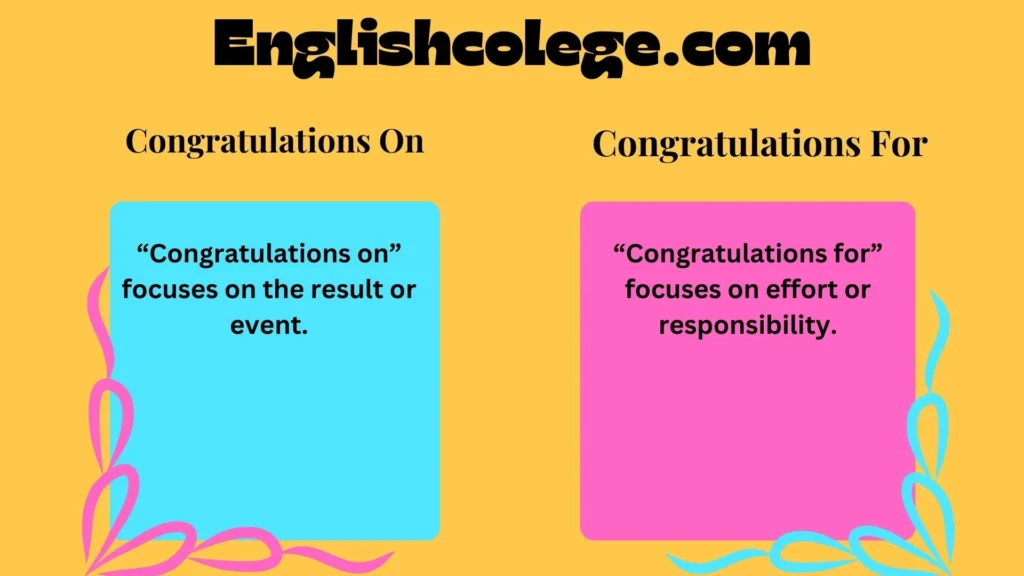
“Congratulations on” focuses on the result or event.
“Congratulations for” focuses on effort or responsibility.
That one idea explains almost everything.
Here’s a quick comparison to lock it in:
| Phrase | Focus | Feels Natural? | Common Usage |
|---|---|---|---|
| Congratulations on | Achievement, milestone, outcome | Very natural | Extremely common |
| Congratulations for | Effort, action, contribution | Less natural | Rare, specific contexts |
Think of “on” as pointing at what happened and “for” as pointing at what someone did.
What “Congratulations On” Really Means
“Congratulations on” connects praise directly to an event, milestone, or outcome. It treats the achievement as a finished thing. A box already checked.
You’ll hear it everywhere because English speakers rely on it instinctively.
Common examples you’ve probably heard
- Congratulations on your promotion
- Congratulations on graduating
- Congratulations on your wedding
- Congratulations on winning the award
- Congratulations on the new job
In each case, the spotlight lands on the result, not the sweat behind it.
Why “on” works so well
The preposition “on” links congratulations to a specific occasion. It acts like a verbal spotlight.
It says: This moment matters. Let’s celebrate it.
That’s why greeting cards, speeches, emails, and social media posts lean heavily toward “congratulations on.”
Case study:
In workplace emails announcing promotions, “congratulations on” appears far more often than “congratulations for,” especially in formal corporate communication.
When “Congratulations For” Is Grammatically Correct
Now here’s where things get interesting.
“Congratulations for” isn’t wrong.
It’s just narrower and more intentional.
Use it when you want to highlight effort, responsibility, or a specific action, especially when the outcome isn’t the main point.
Correct and natural examples
- Congratulations for completing the project under pressure
- Congratulations for your hard work during the campaign
- Congratulations for handling the situation so professionally
Notice the shift. These sentences emphasize process, not just success.
When “for” feels right
- When effort matters more than outcome
- When praising dedication, discipline, or persistence
- When recognizing contribution rather than celebration
That said, even in these cases, many native speakers still default to “on.”
Why? Idiom beats logic in English. Every time.
Achievement vs. Effort: The Hidden Grammar Rule
This distinction explains most confusion.
Use “on” when praising:
- Achievements
- Milestones
- Results
- Life events
Use “for” when praising:
- Effort
- Actions
- Responsibilities
- Behavior
Here’s the same idea rewritten two ways:
- Congratulations on the success of the project
- Congratulations for leading the team so effectively
Both sentences work.
They just praise different things.
Analogy:
Think of “on” as applauding the trophy.
Think of “for” as applauding the training.
Why “Congratulations On” Sounds More Natural in Modern English
Language evolves. Usage wins arguments. And today, “congratulations on” dominates modern English.
Why native speakers prefer it
- It’s idiomatic
- It’s predictable
- It’s safe in almost every context
In spoken English especially, “congratulations on” feels automatic. People say it without thinking.
Even when “for” fits…
Native speakers still say:
- “Congratulations on your hard work”
- “Congratulations on everything you’ve done”
Grammarians might raise an eyebrow.
Real people won’t.
That’s why fluency isn’t about rules alone. It’s about rhythm, habit, and expectation.
Are “On” and “For” Ever Interchangeable?
Short answer: sometimes, but rarely without a shift in tone.
Let’s compare.
| Sentence | What It Emphasizes |
|---|---|
| Congratulations on finishing the marathon | The achievement |
| Congratulations for finishing the marathon | The effort |
Both are correct.
But they don’t feel the same.
When interchangeability causes trouble
Switching prepositions can:
- Change emphasis
- Sound unnatural
- Make writing feel non-native
If you’re unsure, “on” is the safer default.
The Word “Congratulations”: Grammar, Form, and Usage
Here’s a detail many overlook.
“Congratulations” is almost always plural.
Why it’s plural
The word originally referred to multiple expressions of joy or praise. That plural sense stuck.
Is “congratulation” singular ever correct?
Yes, but it’s rare and formal.
Example:
“Please accept my heartfelt congratulation.”
In modern English, this sounds stiff. Even legal or academic writing prefers “congratulations.”
Practical rule
If you’re writing emails, cards, posts, or messages:
Always use “congratulations.”
Structuring Congratulatory Sentences the Right Way
Structure matters more than people think.
Natural sentence patterns
- Congratulations on + noun
- Congratulations on + gerund (-ing form)
- Congratulations for + noun phrase (effort-focused)
Examples
- Congratulations on getting accepted into college
- Congratulations on your engagement
- Congratulations for your dedication to the team
Where people mess up
❌ Congratulations for your wedding
✅ Congratulations on your wedding
Why? A wedding is an event, not an effort.
Real-World Scenarios and Correct Usage
Workplace and professional settings
- Congratulations on your promotion
- Congratulations on closing the deal
- Congratulations on leading the project successfully
Personal milestones
- Congratulations on your new home
- Congratulations on becoming a parent
- Congratulations on your graduation
Academic achievements
- Congratulations on earning your degree
- Congratulations on passing the exam
In almost all these cases, “on” wins.
Advanced Examples: Going Beyond the Basics
As sentences grow more complex, preposition choice becomes more visible.
Longer, natural constructions
- Congratulations on achieving such an impressive milestone after years of dedication.
- Congratulations for staying committed despite constant setbacks.
Notice how sentence length changes emphasis.
Short sentences celebrate.
Longer ones reflect.
Quote:
“Small words carry big meaning. Choose them carefully.”
Responding to Congratulations Gracefully
Receiving congratulations deserves attention too.
Simple and natural replies
- Thank you, I really appreciate it
- Thanks so much, that means a lot
- I’m grateful for your kind words
Slightly more personal
- Thank you, it was a long journey
- Thanks, I couldn’t have done it alone
Avoid robotic replies. Keep it human.
Common Related Grammar Confusions (Quick Reference)

“The reason why” vs. “the reason”
- Better: the reason
- Acceptable in speech: the reason why
“These days”
Correct when referring to the present in general.
“You all” vs. “all of you”
Both correct. Tone and region decide preference.
Short sentences matter
They add confidence.
They breathe life into writing.
FAQs About “Congratulations On” vs. “Congratulations For”
Is “congratulations on” always correct?
Yes, in most situations involving achievements or events, it’s the safest and most natural choice.
Is “congratulations for” wrong?
No, but it’s limited. Use it when praising effort or responsibility rather than outcomes.
Can I use “congratulations on” for effort?
Native speakers do it all the time, even if grammar purists disagree.
Why does “congratulations for” sound awkward?
Because modern English favors idiomatic usage over strict logical structure.
Which phrase should I use in formal writing?
“Congratulations on” works best in formal, professional, and academic contexts.
Final Takeaway: How to Always Choose the Right Preposition
When in doubt, choose “congratulations on.”
It sounds natural.
It fits most contexts.
It won’t raise eyebrows.
Use “congratulations for” only when you want to spotlight effort deliberately.
That’s it. Simple. Practical. Human.
